

Social media often gets handed to whoever is available. A marketing manager runs paid ads, drafts email copy, chases approvals, and then gets asked why Instagram has gone quiet. A founder posts when there’s time, sees uneven results, and starts wondering whether the problem is content, timing, targeting, or the team structure itself.
That’s usually the moment brands start looking at marketing agencies uk and asking the right question. Not “who can post for us?” but “who can help turn social into a measurable growth channel?”
The difference matters. Outsourcing can remove pressure, but the core value comes from bringing in specialist capability that most in-house teams don’t have across content, paid distribution, creator partnerships, reporting, and workflow. That decision sits inside a bigger market shift too. The UK marketing agencies industry is valued at USD 24.89 billion in 2025 and is projected to reach USD 31.50 billion by 2030, reflecting how heavily brands now rely on specialist support during digital transformation, according to UK marketing agencies industry analysis from Mordor Intelligence.
Is It Time to Outsource Your Social Media?

A common pattern shows up before outsourcing starts. Content is inconsistent. Reporting focuses on likes because nobody has time to build proper attribution. Influencer activity gets treated as a bolt-on campaign instead of part of the social strategy. The team stays busy, but the commercial impact stays fuzzy.
That’s when outsourcing starts to make sense. Not because internal teams are weak, but because modern social channels require specialist execution across planning, production, paid support, creator negotiation, analytics, and compliance. One person rarely covers all of that well.
Signs the work has outgrown the internal setup
A brand is usually ready to outsource when several of these issues appear at once:
- The team is reacting, not planning. Posts go live because a calendar needs filling, not because they support launches, lead generation, or sales cycles.
- Creative and performance are disconnected. Organic content sits in one corner, paid sits in another, and nobody joins the dots.
- Influencer work is ad hoc. Creators are sourced campaign by campaign with no repeatable selection criteria or reporting model.
- Leadership wants ROI answers. The team can show activity, but not enough evidence of business contribution.
Practical rule: If social media takes daily effort but still feels separate from revenue, the issue usually isn’t effort. It’s operating model.
A business doesn’t need a massive brief before speaking to agencies, but it does need a clear reason for outsourcing. Better pace, broader skills, stronger reporting, access to creators, or a need for outside strategic oversight are all valid reasons. “We need help” is honest, but it isn’t enough on its own.
What a good outsourcing decision looks like
The best outsourced relationships don’t start with platform tactics. They start with scope. Which channels matter? Who owns approvals? Does the brand need content production, paid amplification, community management, or creator partnerships? Is the priority awareness, enquiries, ecommerce sales, or retailer support?
Brands that need a broader framework before speaking to suppliers can use this guide to outsourced marketing services to map what belongs outside the business and what should stay internal.
For teams already weighing specialist social support, it also helps to understand what a dedicated social media management firm should handle beyond posting. Strategy, creator integration, reporting discipline, and escalation processes matter far more than a polished sales deck.
Define Your Objectives Before You Search
Most agency searches start too early. The shortlist gets built before the brand has defined what success means. That creates vague briefs, vague proposals, and disappointing outcomes.
“Improve our social media” isn’t an objective. It’s a symptom of unclear thinking.
Turn broad ambitions into business goals
A useful objective connects platform activity to a commercial result. That doesn’t mean every goal has to be immediate revenue. It means the agency should know what the social programme is supposed to change in the business.
A practical way to frame objectives is to choose one primary outcome and one supporting outcome.
| Business priority | Better agency objective |
|---|---|
| Brand awareness | Increase reach among a clearly defined audience segment and improve quality of audience engagement |
| Lead generation | Generate more qualified enquiries from specific platforms or content formats |
| Ecommerce | Support product sales through content, creator partnerships, and paid amplification |
| Brand credibility | Build authority through consistent publishing and trusted third-party voices |
The objective should also define the role of influencer marketing early, not later. That matters because influencer activity isn’t separate from social any more. In the UK, influencer marketing is forecast to grow at a 29.5% CAGR from 2025 to 2033, and 50% of UK brands plan budget increases for 2025, according to UK influencer marketing statistics compiled by GoVirAL Global.
Decide where influencer marketing fits
Brands in beauty, sport, travel, lifestyle, and commentary-led categories usually get better results when influencer strategy is baked into the brief from the start. That changes agency selection because the partner needs more than content capability. It needs creator sourcing, contract handling, audience vetting, usage rights awareness, and measurement discipline.
A helpful internal discussion sounds more like this:
- For beauty brands. Should creators drive product education, trust, or launch momentum?
- For sports brands. Is the goal credibility within a niche community or broad awareness through recognisable faces?
- For travel brands. Does the brand need content assets, bookings support, or destination storytelling?
- For social commentary or cultural brands. Does the campaign need opinion-led creators who can hold attention, not just generate views?
The strongest briefs name the job influencer content must do. Without that, creator selection becomes subjective and reporting becomes political.
Write a short objective document
Before contacting agencies, create a brief that answers five things:
- What the business needs to achieve
- Which audiences matter most
- Which channels matter now
- How influencer activity should contribute
- What the internal team can realistically support
This doesn’t need to be long. Two pages is often enough. It just needs to be sharp.
For brands that need help defining that scope before they buy execution, specialist social media consulting can be a better first step than jumping straight into a retainer. A strategy-first process often saves months of misaligned delivery.
How to Vet and Select the Right UK Agency Partner
Buying agency services is difficult because most proposals sound competent. The slides are tidy. The language is polished. The promises are familiar. The gap only appears after kickoff, when the brand realises the agency’s process, team shape, or reporting style doesn’t match what was sold.
That’s why vetting matters more than chemistry.
The wider UK market gives one warning sign. Agencies’ pitch-to-win rate fell by 8% in the last year to 52.4%, according to B2B Marketing’s UK agency report. That drop suggests many pitches aren’t matching what clients need. Brands should assume the burden of qualification sits with them.
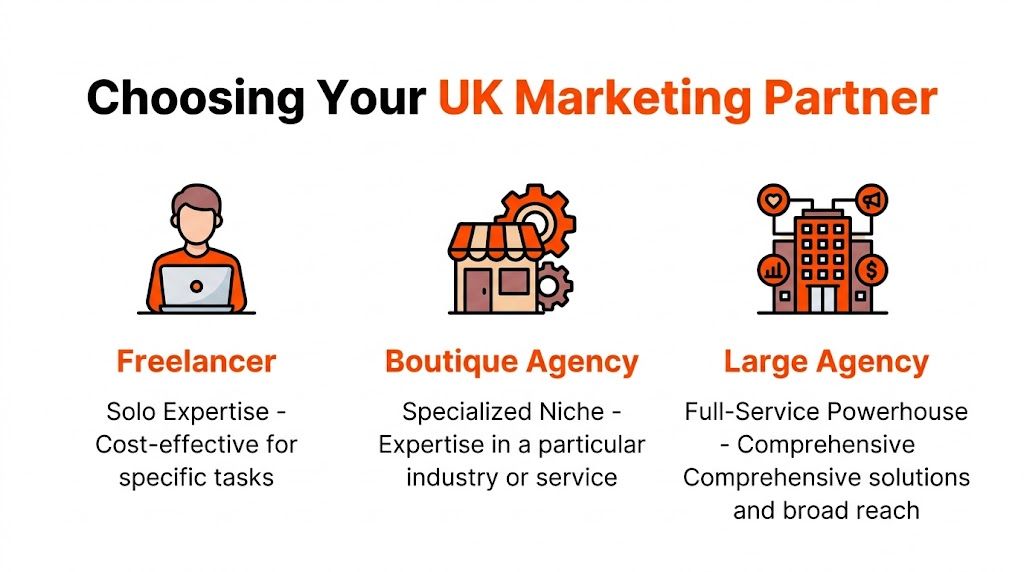
Freelancer, boutique, or large agency
Different partner types solve different problems. The wrong fit often comes from buying the wrong shape of partner, not a bad supplier.
| Partner type | Best fit | Watch-outs |
|---|---|---|
| Freelancer | Specific tasks such as editing, design, or channel support | Can struggle with strategy, scale, cover, or cross-channel delivery |
| Boutique agency | Specialist sectors, tighter collaboration, deeper service focus | May have narrower capacity if the scope expands suddenly |
| Large agency | Multi-market delivery, layered services, bigger stakeholder groups | Can become process-heavy, slower, and less niche in creator work |
A freelancer can work well when the business already has strategy and needs execution help. A large agency can suit complex organisations with multiple departments and procurement layers. A boutique often works best when the brand needs specialist handling, quicker iteration, and sector understanding, especially where social and influencer need to work together.
Questions that expose the real fit
Most buyers ask about pricing too early and process too late. Better questions reveal how the work will run.
Ask potential agencies:
- Who will do the work day to day? Sales teams often pitch senior expertise, but delivery may sit elsewhere.
- How do you choose creators? A serious answer should cover audience relevance, brand fit, content quality, and reporting.
- What happens when performance is off target? Good agencies describe review rhythms and adjustment points, not vague optimisation language.
- How do approvals work? Slow approvals kill social momentum faster than weak ideas.
- How do you handle paid and organic together? If those teams never speak, the account will fragment.
- What rights are included in creator work? Usage, whitelisting, edits, and reposting should be discussed early.
A good agency answers operational questions with specifics. A weak one answers them with adjectives.
What to review beyond the proposal
A proposal isn’t enough. Ask to see examples of reporting. Ask how campaign decisions are documented. Ask what the first month looks like. If the agency works with influencer campaigns, ask how it vets creators and how it handles underperformance, late content, or disclosure issues.
It also helps to review how the agency thinks about category nuance. Beauty requires different creator judgement from travel. Sports requires a different credibility filter from lifestyle. Social commentary requires a stronger view on tone, risk, and public reaction.
A shortlist should get smaller when the questions get sharper.
Brands comparing specialist options in this market may find a curated view of best marketing agencies UK useful, but the final decision still comes down to fit, operating style, and measurement maturity.
Setting KPIs That Actually Measure Success
Most agency relationships don’t fail because nobody worked hard. They fail because both sides report different versions of success. The brand wants business impact. The agency reports activity. Meetings stay polite for a while, then confidence drops.
The fix is simple in principle and demanding in practice. Track both leading indicators and lagging indicators.

Two types of KPI that belong together
A useful framework combines signals that show momentum with outcomes that show commercial effect. According to Mumble Marketing’s guide to agency measurement, this dual-indicator approach is best practice, and 52% of marketers are satisfied with their digital strategy performance when measurement is aligned this way.
Leading indicators are the early signs. Lagging indicators are the business results that arrive later.
| Objective | Leading indicators | Lagging indicators |
|---|---|---|
| Awareness | Reach quality, engagement quality, audience growth | Branded search interest, direct enquiry lift |
| Lead generation | Click quality, landing page engagement, enquiry rate | Qualified leads, sales conversations, acquisition efficiency |
| Ecommerce | Product page visits, add-to-basket behaviour, creator content saves | Orders, revenue contribution, repeat purchase signals |
If an agency only reports lagging indicators, the brand has to wait too long to see whether the work is on track. If it only reports leading indicators, the dashboard can look healthy while the business sees little return.
Good KPIs versus comforting KPIs
Some metrics are useful. Others are merely easy to present.
Good KPI design usually follows these rules:
- Tie each metric to a decision. If engagement drops, what changes?
- Separate quantity from quality. More traffic isn’t enough if it doesn’t convert.
- Assign ownership. Someone must own content quality, paid support, CRM follow-up, and attribution hygiene.
- Review in cycles. Monthly reporting works when it includes action, not just explanation.
Key takeaway: A KPI is only valuable if both sides know what happens when it moves in the wrong direction.
For influencer campaigns, this becomes even more important. Reach and engagement can indicate creative fit, but they don’t prove business value on their own. The brand should agree how creator performance connects to site action, sales intent, or downstream revenue indicators before content goes live.
Brands refining this part of the process often benefit from stronger social media engagement strategies because engagement quality often acts as the earliest signal of whether the content itself deserves paid support or wider rollout.
Creating a Seamless Onboarding and Workflow
A strong agency choice can still produce a weak first quarter if onboarding is messy. Most friction in outsourced social work starts with missing assets, vague approval paths, and confused ownership.
The fix isn’t glamorous. It’s operational.
What the agency needs in the first weeks
The best onboarding packs give the agency enough context to work without guessing. That usually includes brand guidelines, tone of voice notes, visual references, campaign history, product priorities, seasonal timings, audience insights, legal constraints, and current platform access.
A clean handover also covers the practical tools. That might include Meta Business Manager, TikTok account access, GA4, Shopify, Klaviyo, Canva, Dropbox, Notion, Asana, Slack, or Monday.com, depending on the setup. The exact stack matters less than clarity around who has access, who approves what, and where live files sit.
A useful onboarding list includes:
- Brand essentials. Messaging, prohibited claims, competitor context, approved assets.
- Platform access. Admin rights, billing permissions, publishing roles, analytics visibility.
- Commercial context. Product margins, launch windows, retail priorities, stock sensitivity.
- Creator rules. Usage rights preferences, disclosure expectations, approval boundaries.
Build one workflow, not five parallel ones
Social outsourcing breaks down when content, paid media, and influencer activity each run on separate approval chains. A better setup creates one workflow with defined checkpoints.
For example, the agency drafts the content calendar. The client approves themes and priorities. Individual assets move through a single approval window. Paid amplification is decided after early performance signals. Influencer content follows its own legal and brand review, but still sits inside the same reporting rhythm.
That prevents a common problem where creator content performs well but never gets repurposed, boosted, or reused because nobody owns the next step.
Slow feedback causes more campaign waste than weak software ever will.
Choose one point of contact
Many accounts become inefficient because too many people can redirect the work. One client lead should gather internal views, resolve contradictions, and give final direction. That protects speed and keeps accountability visible.
Weekly check-ins tend to work best when they stay focused on actions, blockers, and decisions. Strategy reviews should happen separately from day-to-day approvals. Mixing them creates long meetings and muddy outcomes.
A smooth onboarding rarely feels dramatic. It feels organised, calm, and boring in the right way.
Measuring ROI and Building a Long-Term Partnership
Monthly reports aren’t the goal. Better decisions are the goal.
A productive agency relationship improves when both sides stop treating reporting as proof-of-work and start treating it as a decision tool. That matters even more in specialist influencer programmes, where content can look successful on-platform while underperforming commercially.

Many brands still struggle here. In niche sectors such as beauty, sports, and travel, 62% of marketers report dissatisfaction with agency transparency on performance metrics, according to Digital Agency Network’s discussion of specialist agency selection gaps.
Read performance in layers
A sensible ROI conversation usually works through three layers:
-
What happened on the platform
Did the content hold attention, earn saves, generate clicks, or prompt useful engagement? -
What happened off the platform
Did users visit key pages, submit enquiries, use codes, or move deeper into the funnel? -
What changed in the business
Did the campaign influence sales quality, brand demand, repeat activity, or channel efficiency?
That layered view stops teams from arguing over single metrics in isolation. It also helps when attribution isn’t perfect, which is normal. Social rarely deserves full credit for every result, but it often plays a bigger role than last-click reports show.
Build a partnership, not a reporting ritual
Good long-term relationships improve through review, not loyalty alone. The brand should expect the agency to say what didn’t work, why it didn’t work, and what changes next. That’s more valuable than a glossy dashboard.
For teams that want a practical refresher on the mechanics, this guide on how to measure social media ROI is a useful companion to internal reporting discussions.
The strongest partnerships usually share a few habits:
- They review creative objectively. Not every strong-looking asset is commercially useful.
- They promote winners quickly. Good organic signals should inform paid and creator decisions.
- They keep testing criteria visible. Everyone knows what counts as a win, a miss, or a hold.
- They evolve scope sensibly. New channels and creator formats get added because the data supports them.
A durable agency relationship doesn’t depend on constant excitement. It depends on trust, evidence, and the willingness to adjust.
Frequently Asked Questions
How long should a UK agency need to show traction?
A serious agency should show early signs of traction within the first reporting cycles, especially in content quality, publishing consistency, audience response, and workflow clarity. Commercial results often take longer because attribution, testing, and sales cycles need time. The key question isn’t whether revenue appears instantly. It’s whether the agency can show credible movement in the right leading indicators and explain what happens next.
Should a brand hire one agency for social and influencer work?
Often, yes. That tends to create better coordination between content planning, paid support, creator selection, and reporting. It reduces duplication and avoids the common problem where the influencer agency reports one set of metrics while the social agency reports another. The exception is when a brand already has a strong in-house social team and only needs specialist creator support.
What contract structure works best?
That depends on scope. Retainers suit ongoing strategy, content, community management, and reporting. Project agreements can work for launches, creator campaigns, or audits. The important part is clarity around deliverables, approval windows, rights, reporting cadence, and exit terms.
What should a brand ask about influencer integration?
Ask how creators are selected, how audiences are vetted, what rights are included, how disclosures are managed, and how success is measured beyond surface engagement. If the answers stay vague, the risk sits with the client.
Is a specialist agency better than a full-service one?
Sometimes. Specialist agencies often understand category nuance better, especially in beauty, sport, travel, and commentary-led campaigns. Full-service agencies can be useful when a wider channel mix is needed. The better choice depends on business need, internal capability, and how tightly influencer activity must connect to the wider social programme.
Colossal Influence helps brands, PR teams, and creators build sharper influencer-led strategies across beauty, sports, travel, and social commentary. For teams looking for a UK partner with consultancy depth and hands-on campaign support, Colossal Influence is a strong place to start.
Follow us on Social Media


