

Lionel Messi’s 2022 World Cup victory post is the most liked post on instagram, with 75,471,947 likes verified in March 2023. It took the record from the World Record Egg, which peaked at 60.9 million likes.
That answer is simple. The useful part for brands and creators is understanding why one post reached that level, why so few accounts ever come close, and why chasing record-breaking likes is usually the wrong strategy.
Most articles stop at the leaderboard. That’s not enough for anyone planning campaigns. The bigger lesson sits underneath the ranking itself. A tiny group of global football stars has captured a disproportionate share of Instagram’s top engagement moments, and that changes how marketers should think about reach, creator selection, and what success looks like.
The Reigning Champion of Instagram Likes
Lionel Messi holds the record because his celebratory carousel after Argentina’s World Cup win combined a historic sporting moment with a creator who already commands global attention. Guinness World Records verified the post at 75,471,947 likes on 24 March 2023, after it was published on 18 December 2022, and noted that it overtook the egg image that had reached 60.9 million likes (Guinness World Records record entry).

Why this post matters beyond the headline
The record isn’t just a popularity contest. It’s a case study in how Instagram rewards moments that people feel compelled to publicly endorse. A World Cup win is one of the few events that cuts across countries, age groups, and even casual viewers. The post gave people a chance to participate in that celebration with one tap.
For marketers, that distinction matters. Likes at this level don’t come from content polish alone. They come from cultural significance, timing, and emotional clarity.
A useful benchmark for interpreting results is engagement quality, not just raw volume. Teams comparing creator performance often need a more grounded reference point than celebrity outliers, and SponsorRadar’s guide to creator engagement is a practical place to calibrate what “good” looks like outside record-breaking territory.
Practical rule: Don’t use Messi’s number as a target. Use it as evidence of what happens when platform mechanics and cultural relevance align perfectly.
What brands should take from it
Three immediate takeaways stand out:
- Cultural moments outperform routine posting: Planned content calendars rarely beat major real-world events.
- Emotion wins faster than explanation: Viewers understood the post instantly. No context was needed.
- Massive likes are usually an outcome, not a strategy: Trying to “make a viral post” is far less reliable than being ready when a genuine moment appears.
The most liked post on instagram matters because it shows the ceiling. It also shows how unrealistic that ceiling is for almost everyone else.
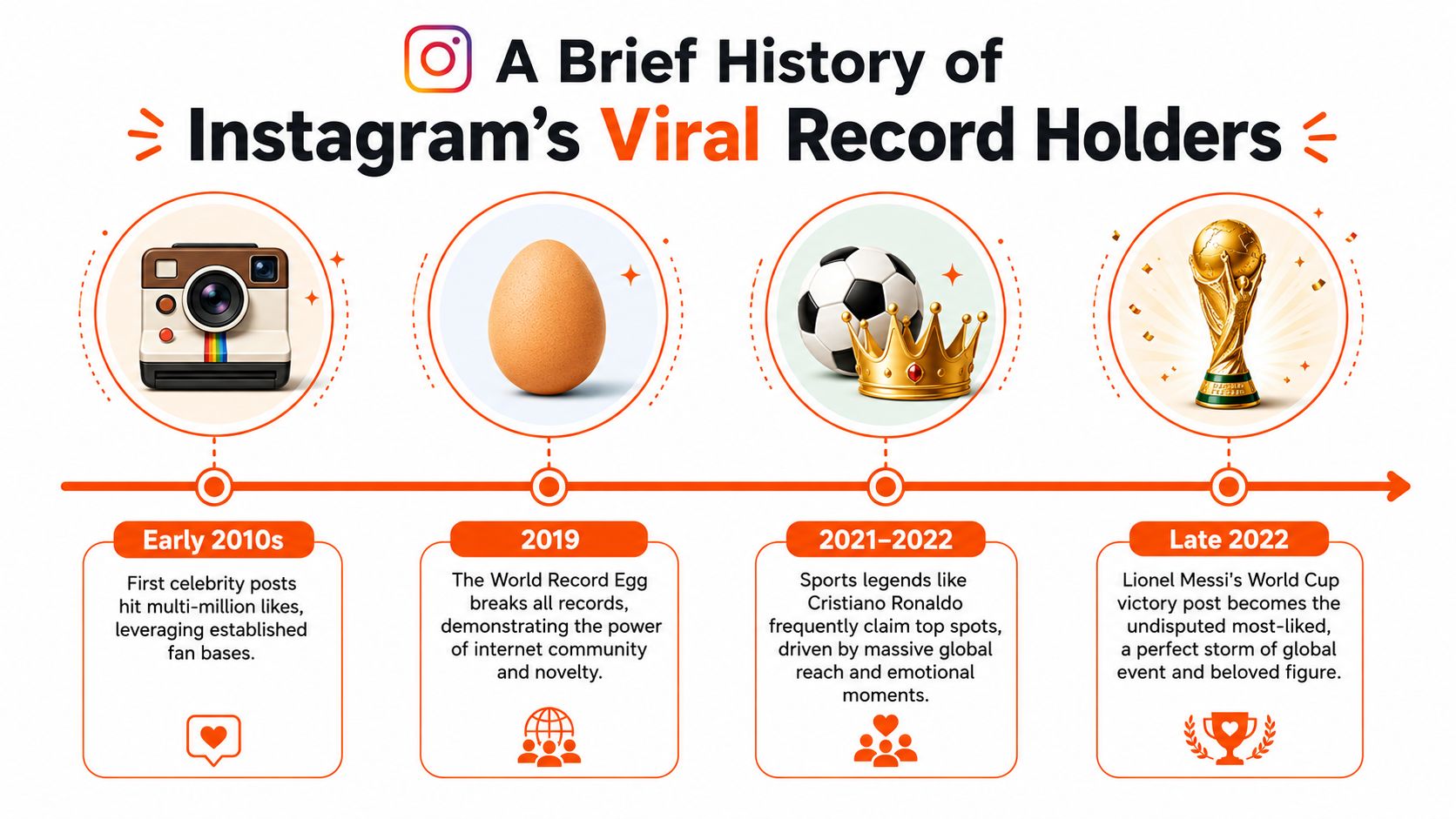
A Brief History of Instagram’s Viral Record Holders
Instagram’s record-holder story says a lot about how virality has changed. Early record-breaking posts were mostly celebrity moments. Established fame did the heavy lifting, and polished personal milestones performed well because they gave fans a reason to respond publicly.
Then the pattern broke.
The egg changed the rules
The World Record Egg didn’t win because of celebrity status, production value, or storytelling craft. It won because the internet treated the post itself as a collective game. People liked it to participate in a shared joke and to push back against the usual hierarchy of influence.
That shift mattered. It proved that Instagram virality could come from anti-celebrity energy just as easily as from celebrity culture. Novelty, simplicity, and collective participation briefly overpowered traditional star power.
The egg’s success showed that users don’t always reward the most polished content. They often reward the clearest invitation to join a moment.
Then football took over
The platform didn’t stay in meme territory for long. Football stars reclaimed the top of the chart, but with a twist. These weren’t just celebrity selfies. The strongest posts combined fame with events that already had global emotional weight.
Lionel Messi and Cristiano Ronaldo now collectively feature in 12 of the top 20 most-liked Instagram posts, and the fourth most-liked post is the 2022 Louis Vuitton chess campaign featuring both players, which exceeded 44 million likes (SocialBoosting’s list of the most liked Instagram posts).
That detail matters because it separates two kinds of viral performance:
| Type of viral post | Why it spreads | What brands can learn |
|---|---|---|
| Anti-celebrity anomaly | Participation becomes the point | Simplicity can outperform polish |
| Celebrity plus cultural event | Fame meets emotional significance | Timing and context matter more than art direction alone |
| Celebrity campaign crossover | Two audiences combine around a recognisable concept | Shared cultural symbols can widen reach |
The strategic read
A list of winners can be misleading if it’s read too strictly. The lesson isn’t “hire the biggest name possible”. The lesson is that virality has moved between three forces: fame, novelty, and cultural relevance. The record-holders changed when one of those forces became dominant.
That’s why the most liked post on instagram isn’t just trivia. It’s a signal that the strongest engagement usually appears when a post feels bigger than the account that published it.
Anatomy of a 75 Million Like Post
Messi’s post didn’t become historic because of one factor. It worked because several powerful mechanics stacked at the same time, and they stacked in the right order.

Engagement velocity came first
The most important technical detail is speed. Messi’s World Cup post gained 50 million likes within the first 24 hours, a pace that signalled to Instagram’s systems that the content deserved broader distribution across surfaces such as Explore and Stories (Wikipedia’s summary of most-liked Instagram posts).
That early acceleration matters more than many teams realise. Instagram doesn’t need long deliberation when users react immediately at scale. Fast engagement acts like proof of relevance.
Signal to watch: A post that earns strong response immediately has a better chance of escaping the creator’s follower base.
For brands, this is why launch timing matters so much. A mediocre post published into a quiet calendar won’t suddenly become culturally central because media spend was added later.
The content format did its job
This wasn’t a single sterile hero shot. It was a carousel. That format matters because it extends attention and lets viewers relive a moment from multiple angles. Celebration, teammates, trophy, confetti, emotion. Every image reinforced the same emotional conclusion.
The post also required no interpretation. Anyone seeing it understood the significance at once. The visual language was universal.
For creators working on campaign assets, that principle is more replicable than the scale itself. Multi-frame storytelling often beats a lone polished image when the goal is emotional immersion. Brands building content around launches, event appearances, or creator trips can apply that same logic in short-form video too, especially when the narrative is planned before shoot day. A useful production reference is this guide to social media video production, because the strongest assets are usually built around sequence, not isolated shots.
Emotion was stronger than branding
The post succeeded because it represented fulfilment, relief, national pride, and sporting history all at once. Those are heavy emotional drivers. They pull in committed fans and casual observers at the same time.
A lot of branded content fails here. It looks expensive but feels emotionally vacant.
Consider the contrast:
- What worked: Immediate, authentic celebration with recognisable stakes
- What doesn’t usually work: Over-scripted endorsement content with no live context
- What brands should emulate: Real reactions, clear stakes, and assets captured close to the moment itself
Reach expanded beyond followers
Many marketers often over-credit audience size. Follower count matters, but it isn’t enough on its own. Plenty of huge accounts post content that performs well without entering record territory.
Messi’s post crossed into mass participation because people didn’t just like Messi. They liked what the post represented. That’s the difference between audience ownership and cultural ownership. The first gives reach. The second creates a moment.
Strategic Lessons for Brands and Marketers
Teams typically can’t buy their way into a record-breaking post, and they shouldn’t plan as if they can. The smarter move is to pull the right strategic lessons from the pattern and apply them at a scale that fits the campaign.

Build around moments, not just media plans
The strongest campaigns aren’t always the most meticulously scheduled. They’re often the ones prepared to move when the right moment appears. That could be a sporting win, a live appearance, a launch milestone, or a creator’s personal achievement.
Brands that perform well on Instagram usually leave space for reactive content. They don’t lock every asset weeks in advance and then force it live regardless of context.
A practical campaign question is simple: if a major cultural moment happened tomorrow, could the team brief, approve, publish, and amplify creator content quickly? If the answer is no, the issue isn’t creativity. It’s operational design.
Choose creators for relevance, not just fame
A huge account can give visibility. It can also give poor fit, inflated expectations, and broad but shallow interest. That’s why creator selection should start with audience alignment and content behaviour, not celebrity status.
Teams planning Instagram partnerships often get better results when they evaluate creators the same way they’d evaluate media placements. Audience overlap, narrative fit, posting style, and likely comment quality matter. A useful overview of channel-specific planning sits in this Instagram influencer marketing guide, especially for brands trying to match creator type to campaign objective.
Big reach is useful. Relevant reach is usually more profitable.
Production quality matters less than emotional truth
Many campaigns falter at this stage. Teams spend heavily on visual control and remove the very spontaneity that makes creator content effective.
That doesn’t mean quality should be ignored. It means production should support authenticity, not suffocate it.
A useful decision framework:
| Campaign need | Better choice |
|---|---|
| Brand introduction in a broad market | Larger creator with cultural recognition |
| Product proof or regional relevance | Mid-tier or niche creator with stronger audience trust |
| Live event amplification | Creator who can publish quickly and naturally |
| Evergreen paid usage | Creator who can deliver clean assets without losing credibility |
Optimise for response, not applause
The most liked post on instagram can tempt marketers into valuing likes above everything else. That’s a mistake. Likes matter as a visibility signal, but campaign success depends on what the audience does next.
Strong strategy asks different questions. Did the post create conversation? Did it fit the creator’s voice? Did it produce reusable assets? Did it give the paid team material worth amplifying? Did the audience see themselves in the content?
Those questions produce better campaigns than chasing vanity metrics alone.
The Creator Monopoly on Engagement
This is the uncomfortable part of the leaderboard. The top of Instagram isn’t just competitive. It’s concentrated.
Analysis shows that Lionel Messi and Cristiano Ronaldo dominate 12 of the top 20 most-liked Instagram posts, creating a market saturation problem for brands. The same analysis argues that mid-tier UK creators in the 50K to 500K follower range often deliver better conversion metrics for regional campaigns (Brandwatch’s analysis of the most liked Instagram pictures).
That changes the strategic interpretation of “best performing content”. If a brand benchmarks itself against global football icons, it will almost certainly set the wrong targets and choose the wrong creators.
Why monopoly distorts planning
When two creators occupy so much of the visible top end, they warp expectations in three ways:
- Benchmark inflation: Teams start treating exceptional engagement as normal ambition.
- Budget distortion: Senior stakeholders assume bigger names are the safest route.
- Creative flattening: Campaigns imitate celebrity formats that don’t translate to niche audiences.
Here, a lot of influencer strategy becomes less efficient. A fashion, travel, beauty, or regional retail brand usually doesn’t need the broadest possible audience. It needs the most responsive one.
The better opportunity sits lower down the market
Mid-tier creators are often underused because they don’t dominate headlines. That’s exactly why they can be effective. Their audiences are narrower, but the relationship is often clearer. Followers know what those creators talk about, why they’re worth listening to, and what kind of recommendation feels credible.
For a regional activation, a product launch with clear audience fit, or a trust-sensitive category, that can outperform a star-driven awareness play.
A useful way to approach creator discovery is to review category specialists, not just household names. Lists such as these top UK influencers are valuable when the goal is fit by vertical, geography, or audience style rather than sheer celebrity.
If a creator monopoly exists at the top, the opportunity is to stop buying the top by default.
What works in practice
Brands usually get stronger outcomes when they separate fame from fitness. Mega-creators are powerful when the brief calls for broad attention and cultural weight. Mid-tier creators are stronger when the brief needs trust, explanation, localisation, or repeated audience exposure.
The market doesn’t reward brands for choosing the biggest name. It rewards brands for choosing the right name.
Actionable Takeaways for High-Engagement Content
The most liked post on instagram is useful as a reference point, but it’s a poor template if copied blindly. The right move is to extract the mechanics and apply them realistically.
A working checklist for creators and brands
-
Anchor content to identity: Posts that exceed 40+ million likes typically trigger identity-affirming reactions, and those posts generate 3-5x more shares and cross-platform virality (Influize analysis of the most liked photos on Instagram). The practical lesson is to ask what the audience is signalling by engaging. Pride, belonging, aspiration, humour, taste, or allegiance all travel well.
-
Use formats that unfold: Carousels, sequenced short-form video, and post-event recaps usually outperform one-off assets when the moment has multiple emotional beats.
-
Publish close to the moment: Delayed content often loses the emotional charge that made it worth posting in the first place.
-
Brief creators around a feeling, not a script: Give them the message, the boundaries, and the absolute requirements. Don’t strip out their natural voice.
-
Match creator tier to campaign goal: Awareness can justify large creators. Consideration and conversion often favour narrower, more trusted voices.
-
Set realistic KPIs: Record-breaking likes are outliers. Better benchmarks come from category fit, creator history, saves, shares, comments, click behaviour, and asset reusability.
What usually fails
Some patterns repeatedly underperform:
| Common mistake | Why it underperforms |
|---|---|
| Chasing virality as the sole brief | The content becomes generic and opportunistic |
| Overproducing creator assets | The post loses the creator’s natural tone |
| Choosing reach over fit | The audience notices the mismatch |
| Measuring only likes | Business impact becomes impossible to judge |
For creators operating meme-led or trend-reactive pages, workflow matters too. Teams managing high-volume content often use specialist resources such as AI tools for meme page managers to speed up iteration without losing posting momentum. The same principle applies more broadly. Faster testing beats overthinking.
The strongest operating habit is consistency in review. Audit what earns comments, shares, saves, reposts, and follow-on content opportunities. Then refine from there. For teams that need a structured improvement process, these social media engagement tactics offer a practical starting point for turning raw performance into repeatable process.
The headline number belongs to Messi. The more useful lesson belongs to any team willing to stop copying outliers and start building for relevance, timing, and audience fit.
Brands, agencies, and creators that want a sharper influencer strategy can work with Colossal Influence to plan campaigns, source the right talent, and turn engagement into measurable commercial outcomes.
Follow us on Social Media


