

Are the posts really underperforming, or is the strategy measuring the wrong thing?
A lot of brands still treat engagement as a thin layer on top of publishing. They post, wait, count likes, then assume the audience either “gets it” or doesn’t. That’s usually the wrong diagnosis. Most weak engagement comes from a broken system: vague audience insight, content that asks for nothing, inconsistent community management, and reporting that rewards visibility over response.
For UK brands and creators, knowing how to increase social media engagement isn’t about collecting more surface-level reactions. It’s about building repeated, meaningful interaction that turns content into conversation, and conversation into commercial value. Comments, saves, shares, replies, DMs, sticker taps, duets, and user submissions all tell a stronger story than follower count on its own.
That matters even more in influencer marketing, where the difference between a campaign that travels and one that stalls often comes down to how people participate, not just how many people see it. Teams that understand social media comments analysis usually get a clearer read on audience intent, objections, and emotional response than teams that only look at reach.
A lot of confusion also starts with a fuzzy view of the channel itself. Brands still asking whether creators belong inside the media plan usually need a cleaner definition of influencer marketing before they can build engagement properly. Once that’s clear, engagement stops looking like a vanity metric and starts looking like an operating system for trust.
Beyond Likes and Follows Redefining Social Media Engagement
Likes are easy to spot and easy to report. They’re also one of the least useful ways to judge whether social is doing its job.
Real engagement is behavioural. It shows up when someone replies with context, saves a post for later, shares it to a friend, joins a poll, sends a DM, stitches a video, or contributes content to a branded theme. Those actions require more effort. Effort is what separates passive exposure from active interest.
What engagement signals
For a brand, engagement tells three different stories at once:
- Relevance: people saw the content and found it worth reacting to
- Resonance: the message connected strongly enough to prompt a response
- Relationship: the audience expects the account to be worth returning to
That third point gets missed most often. Strong engagement isn’t just a content outcome. It’s a community habit. When people expect useful posts, familiar formats, and responsive conversation, they stop treating the account as a billboard.
Engagement becomes more valuable when it creates expectation. An audience that comes back on purpose is far more useful than one that scrolls past by accident.
Why vanity metrics distort decision-making
Follower count can rise while relevance drops. Reach can spike because of one trend-led post that never converts into repeat attention. Even likes can climb on lightweight content that doesn’t build trust or move someone closer to action.
That’s why random tactics rarely hold. A giveaway might create a burst. A meme might travel. A reactive trend post might attract attention for a day. But if none of that fits the brand voice, platform behaviour, or community rhythm, the account ends up busy rather than effective.
Over time, the brands that win usually do four things well:
| Focus area | Weak approach | Strong approach |
|---|---|---|
| Audience understanding | Broad assumptions | Clear behavioural insight |
| Content planning | One-off ideas | Repeatable content pillars |
| Community management | Delayed or generic replies | Active, platform-aware dialogue |
| Measurement | Likes and follower growth | Response quality and interaction patterns |
That shift matters more than any single hack. Social teams don’t need more noise. They need a framework that turns engagement into an asset they can build, protect, and improve.
Laying the Groundwork for Genuine Connection
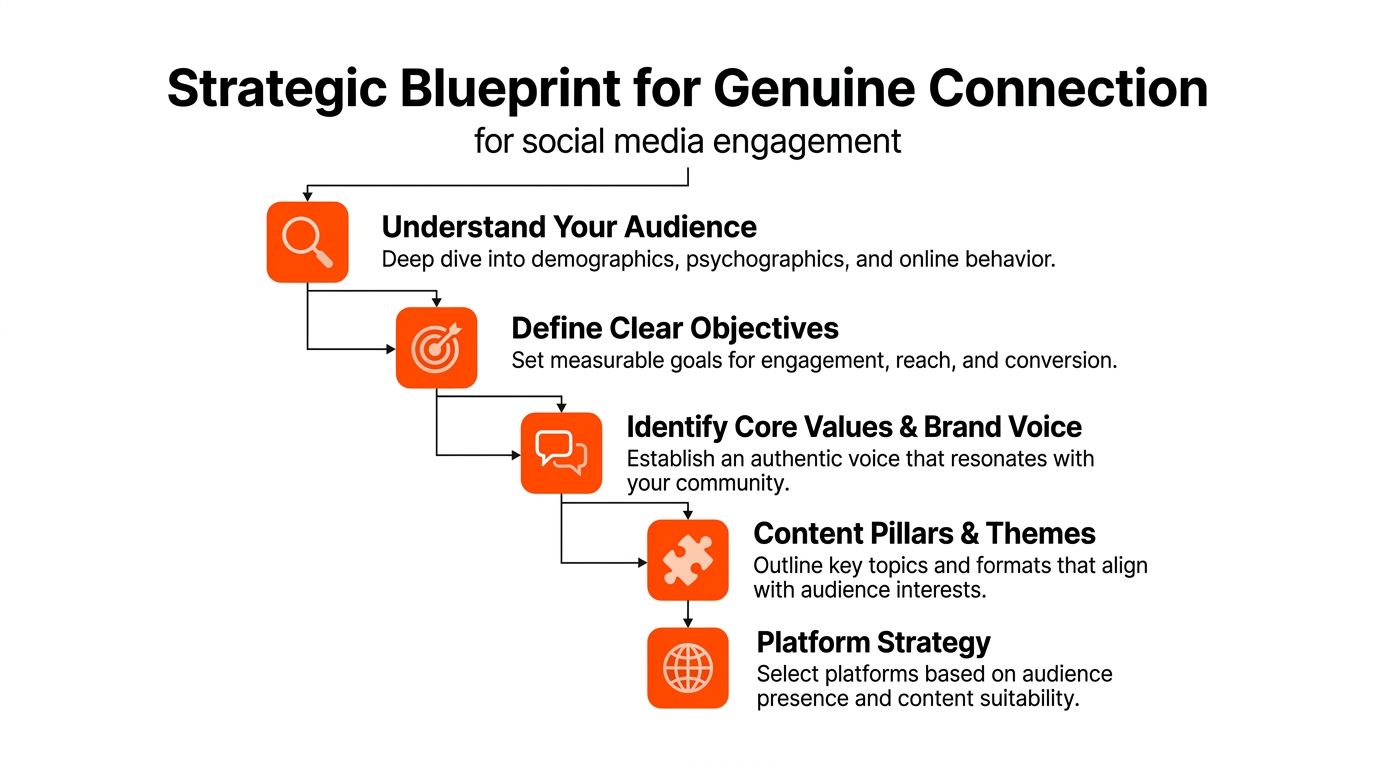
Most engagement problems start before the first post goes live. Brands often blame creative when the underlying issue is strategic fog. They haven’t defined who they want to reach, what reaction they want, or which platform deserves the effort.
This planning stage is where the quality of future engagement gets decided.
Start with behaviour, not demographics alone
“Women 25 to 34 in London” isn’t a useful social strategy. It describes a group, not a pattern.
A better audience profile combines demographics with signals such as what they comment on, which creators they already trust, which formats they complete, and what kind of language they use when they engage. Social listening tools help. So does manual review of competitor comments, creator communities, and brand mention threads.
Useful audience questions include:
- What prompts them to respond? Some audiences answer direct questions. Others react more to opinion-led posts, humour, or behind-the-scenes content.
- Where do they want to interact? A travel audience may save and share destination content. A sports audience may prefer fast opinions and reactive comments.
- What do they ignore? This is often more valuable than knowing what they like.
Set engagement objectives that connect to business goals
Engagement only matters if it serves a business outcome. That could mean stronger product education, more qualified traffic, more UGC for paid reuse, a warmer audience for creator partnerships, or better retention among existing customers.
A practical objective should answer four questions:
- What interaction matters most? Comments, shares, saves, sticker taps, DMs, duets, or submissions.
- Why does it matter? Each action reflects a different level of intent.
- Which content pillar should drive it? Educational, social proof, entertainment, product use, or founder voice.
- What decision will the data influence? Budget, format mix, creator selection, posting schedule, or moderation resourcing.
Practical rule: if a team can’t explain what a comment, save, or share is supposed to lead to, the engagement goal is still too vague.
Choose platforms by interaction quality
Not every platform deserves equal effort. Resource should follow response quality.
For UK marketers, timing and interaction design matter. Posts that spark mid-length comments of 50 to 99 characters gain 151.6% more engagement on average, and platform benchmarks show LinkedIn at 6.50%, Facebook at 5.07%, and Instagram’s median at 0.61% in 2025, according to Hootsuite’s reporting on social media engagement trends and timing tools like Best Time to Publish at blog.hootsuite.com/social-media-engagement.
That doesn’t mean Instagram has no value. It means brands should stop assuming every platform plays the same role. A B2B consultancy may build deeper discussion on LinkedIn. A consumer brand may still use Instagram for visual proof, but with lower expectations for open-comment conversation and a stronger focus on Stories, creator posts, and saves.
Build a planning model that teams can use
A workable framework doesn’t need a fifty-slide deck. It needs a short operating model.
- Audience lens: one-page summary of motivations, objections, and preferred interactions
- Content pillars: three to five repeatable themes with clear purpose
- Platform role: what each channel is expected to do
- Response rules: who replies, how fast, and in what tone
- Review cadence: weekly check on patterns, not just performance totals
A structured foundation reduces guesswork. It also makes creative better, because every post has a reason to exist before it’s designed.
Creating Content That Demands a Response
Content earns engagement when it gives people something specific to do, say, compare, or contribute. That sounds obvious, but a lot of social calendars still consist of announcements disguised as content.
Audiences rarely respond to polished updates with no opening. They respond to tension, perspective, participation, and proof from people like them.

UGC works because it lowers the distance between brand and audience
A branded post tells people what the company wants them to know. User-generated content shows how people experience the product, service, destination, or community. That difference matters.
In the UK, UGC drives 28% more engagement than branded content and is seen as 2.4x more authentic. On Instagram, carousel posts achieve 1.92% engagement, ahead of single images at 1.74% and videos at 1.45%, which makes carousels a strong format for showcasing UGC, according to Sprinklr’s social media marketing statistics at www.sprinklr.com/blog/social-media-marketing-statistics.
That creates a practical playbook for brands in beauty, travel, lifestyle, and sport:
- Collect proof at the source: ask customers, attendees, or creators for content around a specific use case, not a vague “tag us”.
- Package it in carousels: lead with the strongest visual, then build context with product use, reactions, or mini testimonials.
- Credit properly: visible attribution helps trust and increases the chance of future submissions.
- Add a response prompt: “Which look would you wear?”, “Which destination would you book?”, “Which routine would you try first?”
Interactive features should reduce friction
Stories, polls, quizzes, “Add Yours” stickers, TikTok duets, and comment-reply videos work because they ask for a low-friction action. That’s useful when an audience isn’t ready for a long comment.
A beauty brand can post a Story poll asking whether followers prefer a dewy or matte finish, then follow it with creator clips showing both. A travel brand can use “Add Yours” to invite followers to share hidden UK weekend spots. A sports creator can turn a comment into a TikTok reply video and let the audience shape the next post.
These formats work best when they feed a larger system, not when they’re used once and forgotten.
Build content around response triggers
The strongest engagement posts usually include at least one of these triggers:
| Trigger | What it does | Example |
|—|—|
| Contrast | invites opinion | “Which version works better?” |
| Identity | encourages self-expression | “What kind of traveller are you?” |
| Specificity | makes replying easier | “What’s one item you never pack without?” |
| Participation | turns audience into contributor | branded hashtag or “Add Yours” thread |
| Social proof | validates attention | customer result, routine, or creator usage |
A post doesn’t need to be loud to be engaging. It needs to create an easy next step for the audience.
Storytelling beats product listing
A product grid rarely gets discussed. A product in context often does.
That’s why creator-led content usually outperforms rigid brand messaging. The format isn’t magic. The context is. People respond when content answers real questions, mirrors a familiar problem, or shows a believable use case.
A travel post framed as “three things that made this weekend trip easier” is more discussable than “our travel essentials are available now”. A fitness creator showing what changed in a training bag setup gives followers something to compare against their own habits. A skincare carousel with “morning routine for rushed weekdays” is easier to save and share than a standalone product shot.
For brands that need stronger visual execution, social media video production can support creator-led and brand-led formats alike, especially when content needs to be built around education, demonstration, or repeatable series rather than one-off campaign assets.
What usually doesn’t work
Some content gets published because it feels safe. Safe content often gets ignored.
Common weak spots include:
- Generic promotional copy: too polished, too broad, no invitation to respond
- Trend chasing without fit: attention may come in, but relevance leaks out
- Over-designed static posts: visually tidy, emotionally flat
- One-note CTAs: asking for comments without giving anyone a reason
Good engagement content doesn’t beg for interaction. It earns it by making the response feel natural.
From Broadcast to Dialogue Master Community Interaction
Strong content opens the door. Community management decides whether anyone stays.
A surprising number of brands still treat comments and DMs as admin. That’s a mistake. The comment section is often where trust gets built, objections surface, and passive viewers decide whether the account is worth following closely.

Response timing should follow platform behaviour
Not every platform rewards replies in the same way. That matters when a team is deciding where to spend moderation time and how quickly it needs to react.
Buffer’s analysis found that Threads gains a 42% engagement lift with replies, LinkedIn sees a 30% lift, and Bluesky only 5%, which makes community management a platform-specific investment rather than a generic best practice, as reported at buffer.com/resources/social-media-engagement-guide.
That kind of difference changes the workflow. If a brand is active on Threads and LinkedIn, rapid comment response deserves more staffing attention there than on lower-return channels. A one-size-fits-all SLA won’t reflect how audiences behave.
Treat replies as part of the content
The brands and creators that sustain engagement don’t just answer questions. They extend the conversation.
That means:
- replying with context rather than a single emoji
- pulling good audience questions into future posts
- acknowledging useful disagreement without becoming defensive
- using comment themes to shape content sequencing
A reply can also become a public signal. When people see thoughtful responses, they’re more likely to add their own. Silence has the opposite effect. An unanswered thread makes the account feel static.
Community management isn’t customer service bolted onto content. It’s part of the content experience.
Build recurring interaction, not isolated spikes
One-off engagement can be bought with novelty. Ongoing engagement comes from routine.
The most durable structures are often simple:
| Recurring format | Why it works | Best use |
|---|---|---|
| Weekly Q&A | builds expectation and lowers reply friction | founders, coaches, creators |
| Themed day posts | gives followers a reason to return | beauty tips, travel picks, sports takes |
| Branded hashtag prompts | creates contribution loops | UGC collection and discovery |
| Comment-led follow-ups | shows the audience shaped the content | product education and FAQs |
At this stage, understanding what user-generated content is becomes commercially useful rather than theoretical. Once a brand knows how to source, permission, organise, and reuse audience contributions, community interaction stops being reactive and starts feeding the content engine.
What responsive brands do differently
A broadcast mindset says, “the post is finished once it’s published.”
A dialogue mindset says, “publishing starts the useful part.”
That change affects tone as much as timing. Generic “Thanks for sharing” replies rarely move the conversation forward. Better responses pick up on the detail in someone’s comment, ask a follow-up, or point them to the next relevant post, Story, or creator contribution.
It also affects moderation standards. Teams need clear rules for praise, criticism, product questions, off-topic comments, and creator-tagged posts. The point isn’t to script every reply. It’s to keep the voice recognisable and human.
Habits beat bursts
Many brands spend heavily on campaign moments, then disappear between launches. That creates peaks without continuity.
A better model is to keep the audience in motion between major pushes. A regular live, a weekly roundup, a standing audience question, or a recurring creator feature gives people a predictable reason to return and respond.
The strongest communities rarely form around a single viral post. They form around repeated signals that participation will be noticed, valued, and used.
Measuring What Matters to Refine Your Strategy
Engagement improves when teams stop reporting everything with equal weight. A like, a save, a DM, and a thoughtful comment aren’t interchangeable. They signal different levels of attention and different types of intent.
The job of analytics isn’t to produce more dashboards. It’s to help a team decide what to repeat, what to cut, and where to invest more effort.
Track indicators that match the strategy
If the goal is stronger community conversation, comment quality matters more than raw impressions. If the goal is audience advocacy, shares and tagged mentions tell a better story. If the goal is content depth, saves and repeat views deserve attention.
A practical review stack often includes:
- Comment quality: are people adding substance, asking questions, or tagging others with intent?
- Share pattern: which posts get passed on, and what kind of message travels?
- Save behaviour: what content gets stored for later use?
- Response load: where is the team spending time in comments and DMs?
- Format performance: which content types attract the strongest interactions, not just the widest reach?
Compare recurring formats against sporadic posting
One of the most useful measurement lenses is consistency.
Emerging engagement research suggests that weekly recurring live sessions and UGC systems with branded hashtags are underused, while recurring series content can drive 2-3x higher follower retention than sporadic posting, according to chej.org/8-strategies-to-grow-your-social-engagement. That matters because retention is often the missing piece in social reporting. Teams celebrate spikes but ignore whether people keep coming back.
Here, a simple comparison table helps.
| Content pattern | What to review | Typical question |
|---|---|---|
| Recurring series | repeat interaction over time | are the same people returning and responding? |
| One-off trend post | short-term lift | did attention convert into meaningful follow-on behaviour? |
| UGC prompt | contributor volume and quality | did the audience participate, or just observe? |
| Live session | questions, replies, and post-live discussion | did the format create conversation beyond the event itself? |
The right metric is the one that changes a decision. If a number looks neat in a report but doesn’t affect the next move, it’s mostly decoration.
Use testing to make content sharper
Testing doesn’t need to be complicated. It does need discipline.
A team might compare:
- Carousel vs short-form video for the same topic
- Direct question vs opinion-led hook
- Creator face-led opening vs product-first visual
- Scheduled recurring post vs ad hoc publishing
The point isn’t to “win” one format forever. Audience behaviour shifts by platform, category, and season. Testing shows where current attention sits.
Timing analysis matters too. Brands that publish on YouTube alongside short-form channels should align upload habits with audience behaviour rather than broad assumptions. Reviewing resources such as best time to upload to YouTube can help teams think more clearly about timing as part of engagement design, not just distribution.
Build a usable feedback loop
Good analytics ends in action. After each review cycle, the team should be able to answer:
- Which posts triggered the strongest contribution?
- Which topics produced low-effort engagement only?
- Which comments reveal audience confusion or buying friction?
- Which recurring formats deserve another month of investment?
- Which platform is consuming resource without enough return?
That loop is what turns social from content production into compounding performance.
Making Engagement Your Most Valuable Asset
The brands that improve engagement consistently rarely rely on tricks. They operate a system.
They understand the audience well enough to create relevant prompts. They publish content that invites participation instead of just broadcasting updates. They treat comments, DMs, and creator interactions as strategic touchpoints. Then they measure the behaviours that signal trust, relevance, and repeat attention.
That’s an important answer to how to increase social media engagement. Not more posts for the sake of volume. Better alignment between planning, content, interaction, and review.
A lot of social advice still focuses on isolated tactics. That’s useful up to a point. For teams trying to build something more durable, resources on how to improve social media engagement that lasts are helpful because they reinforce the idea that sustainable engagement comes from repeatable habits, not occasional wins.
Engagement becomes a strategic asset when it does three things at once. It sharpens audience insight. It strengthens creator and brand credibility. And it gives the team a clearer path to better content decisions over time.
When those pieces work together, social stops feeling unpredictable. It becomes far more manageable, and far more valuable.
If your brand needs a clearer engagement system across creators, platforms, and campaign reporting, Colossal Influence works with brands, PR teams, and influencers on strategy, creator partnerships, and content structures built to generate stronger audience response.
Follow us on Social Media


