
Social media video isn't just about pointing a camera and hitting record. It's the whole process: the initial idea, the filming, the editing, and finally, getting it out there on platforms like TikTok, Instagram, and YouTube. To do it right, you need a plan that's specifically designed to grab attention and hit your marketing goals, because what works on one platform will fall flat on another.
It all starts with a solid plan, long before you even think about filming.
Building Your Video Strategy From the Ground Up
Before you press record, you need a strategy. Seriously. Just making content and hoping for the best is a fast track to wasting time and money. Think of the pre-production phase as laying the foundation; it’s where you decide what every video is for, who it’s for, and how it fits into your bigger marketing picture.
This is where you figure out what success even looks like for you. Is it about getting your brand name out there? Driving people to your website? Shifting a new product? Each of these goals needs a totally different creative touch. A funny, shareable skit might be perfect for brand awareness, but a clear product demo with a strong call-to-action is what you need to make sales.
Define Your Objectives and Audience
First things first, set clear, measurable goals. Don't just say you want "more engagement." Aim for something specific, like a 15% increase in follower engagement or a 10% rise in clicks to your landing page. Having real numbers helps guide your creative choices and makes it much easier to see if what you're doing is actually working.
Just as important is knowing who you're talking to. You need to get under the skin of your target audience. What are their interests, their demographics, their online habits? What kind of content are they already watching and sharing? Figuring this out helps you create videos that feel genuine and actually connect with them. Many brands find it easier to tap into specific audiences by working with a specialised UK influencer agency who already have those connections.
This whole strategic process is mapped out below.
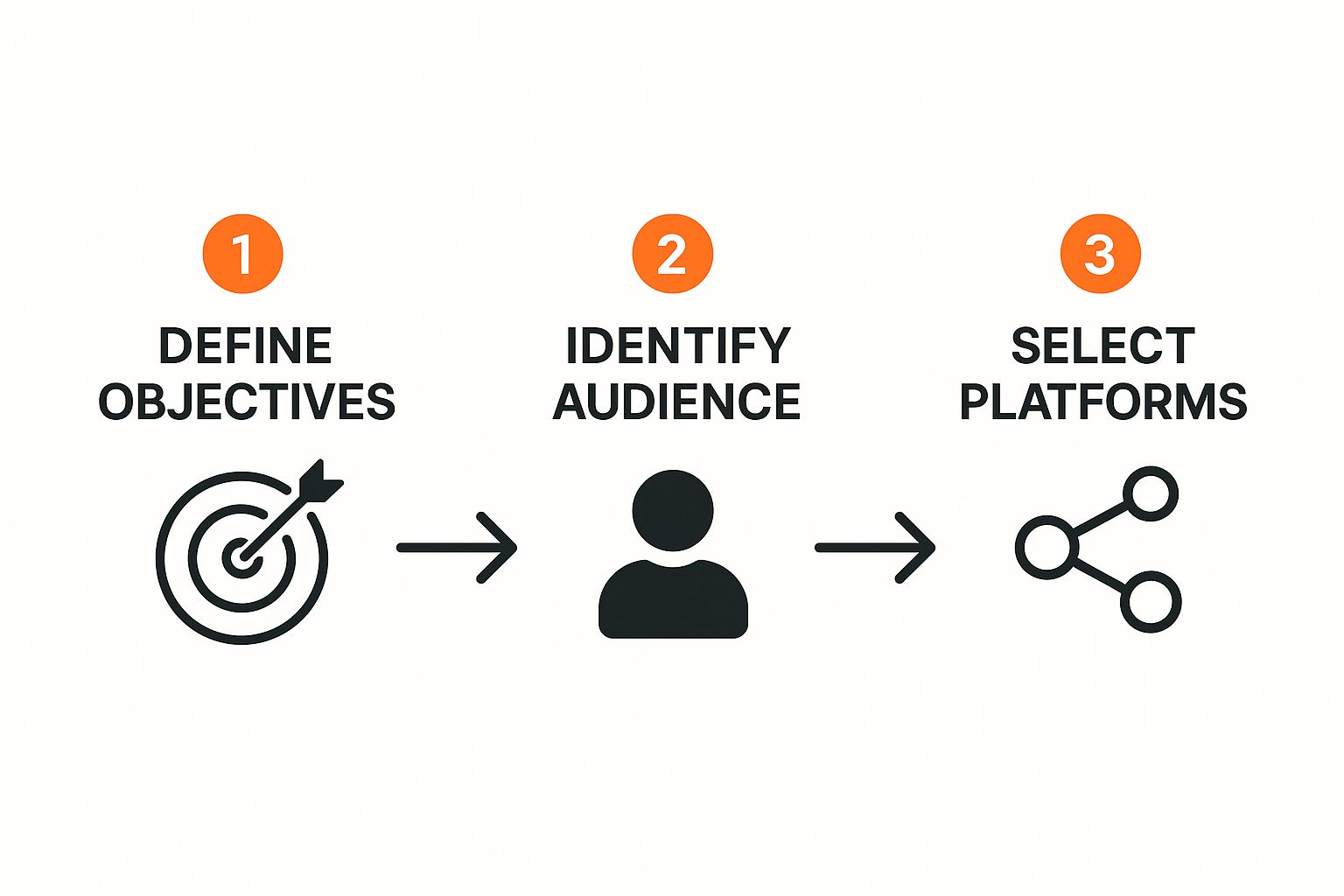
As you can see, figuring out your goals and your audience has to happen before you can even begin to choose the right platforms for your content.
Select Platforms and Brainstorm Content
Different platforms are built for different types of video. Here in the UK, video on Instagram and TikTok absolutely crushes static images when it comes to engagement. With Instagram alone reaching 48.2% of the UK population, its Reels can pull in 122% more users than a single photo. That tells you everything you need to know about where audience attention is heading.
Once you’ve got your goals, audience, and platforms sorted, the fun part begins: brainstorming. Don't overthink it at first, just get some ideas down.
- Educational Content: Think how-to guides, quick tips, or tutorials that give your audience real value.
- Behind-the-Scenes: Show off your company culture, your creative process, or the people behind the brand. It builds a human connection.
- User-Generated Content (UGC): Share videos from your customers. It’s authentic social proof and builds a real sense of community.
To help you decide where to focus your efforts, here's a quick breakdown of what works best on the major platforms in the UK.
Platform-Specific Video Strategy
| Platform | Best Video Formats | Optimal Length | Content Style & Tone |
|---|---|---|---|
| TikTok | Vertical video (9:16) | 15-60 seconds | Trendy, humorous, raw, music-driven. Highly informal and creative. |
| Reels (9:16), Stories (9:16), In-Feed (1:1 or 4:5) | Reels: 15-90 seconds; Stories: 15 seconds per clip | Polished, aesthetic, inspirational, educational. Can be both casual (Stories) and high-quality (Reels). | |
| YouTube | Horizontal video (16:9), Shorts (9:16) | Long-form: 5-15+ minutes; Shorts: Under 60 seconds | In-depth, educational, entertaining, vlogs. Authority-building and storytelling. |
| Square (1:1), Vertical (4:5), Horizontal (16:9) | 1-3 minutes | Community-focused, informative, emotional storytelling. Aimed at a slightly older demographic. | |
| Horizontal (16:9), Square (1:1) | 30 seconds – 5 minutes | Professional, insightful, industry news, thought leadership. Tone is business-formal. |
Choosing the right platform and format is half the battle. This table should give you a solid starting point for tailoring your content to meet audience expectations where they are.
Getting this groundwork right is crucial. To make sure your entire process is on point, it’s worth getting familiar with some core video marketing best practices. This prep work is what separates videos that just get views from videos that get real, measurable results.
Capturing High-Quality Footage on Any Budget

Here’s a secret: great social media videos are built on great footage, but you absolutely don’t need a Hollywood budget to look professional. In fact, the camera already in your pocket is more than capable of producing incredible results if you know how to use it.
Effective social media video production is far less about expensive gear and much more about mastering the fundamentals. Getting the core principles of lighting, stability, and sound right will instantly elevate your content in a way a new camera never could.
These are the elements that separate those wobbly, amateur clips from the polished, engaging videos that actually stop the scroll.
Optimising Your Smartphone for Video
Before you even think about dropping cash on an expensive camera, let’s talk about your phone. It's your most accessible tool, and with a few tweaks, it can be a powerhouse. The goal is simple: stabilise your shots and drastically improve your audio.
A wobbly video is one of the fastest ways to make someone click away. It just screams unprofessional.
Even a very basic setup can make a world of difference:
- Invest in a tripod: A small, flexible tripod for your phone is an affordable game-changer. It guarantees steady, professional-looking shots every single time.
- Use an external microphone: Your phone's built-in mic is designed to pick up everything, including all that distracting background noise. A simple lavalier (lapel) mic that clips onto your shirt will capture crisp, clear dialogue instead.
- Find good lighting: Natural light from a window is your best friend. Seriously. Always try to position yourself facing the light source to avoid nasty shadows and create a clean, bright look.
These small, cheap investments provide a massive return by immediately boosting your production quality.
Mastering the Fundamentals of Filming
With your basic gear sorted, it’s time to focus on technique. The way you frame your shots and manage your sound are critical skills for anyone creating video content.
Poor audio, in particular, is a total non-starter. Viewers will forgive slightly average video quality, but they absolutely will not tolerate bad sound. It's just too distracting.
Always aim to record the highest-quality audio possible in any situation. This usually means getting your microphone as close to the person speaking as you can and doing a quick check for any humming fridges or noisy traffic before you hit record.
A key takeaway for any aspiring social media videographer is that audiences will often abandon a video with poor audio much faster than one with slightly imperfect visuals. Clear sound keeps people engaged with your message.
Knowing When to Upgrade Your Equipment
There will eventually come a point where your smartphone setup might start to feel a bit limiting. Maybe you're finding you need more control over settings like aperture and shutter speed for a more cinematic feel, or you need to shoot in tricky low-light conditions.
If that sounds like you, it might be time for an upgrade.
Consider upgrading when you start running into these limitations:
- You need more lens options: A DSLR or mirrorless camera opens up a world of different lenses (like wide-angle or telephoto) that let you get far more creative with your shots.
- Low-light performance is crucial: The larger sensors in dedicated cameras perform significantly better in dimly lit environments, producing much cleaner, less grainy footage.
- You require advanced manual controls: For specific artistic effects like that lovely blurred background (known as bokeh), a dedicated camera gives you the manual control your phone simply doesn't have.
But even after you upgrade, the principles remain the same. A new camera won't magically fix poor lighting or shaky hands. Mastering the basics first ensures that when you do decide to invest in better gear, you'll know exactly how to get the most out of it.
Turning Raw Clips into Compelling Stories
This is where the magic really happens. Editing is the bridge between a folder full of raw footage and a polished, engaging narrative that actually connects with your audience. It’s arguably the most creative part of the entire process, turning simple clips into stories that get people to stop scrolling and take action.
Don't let the thought of post-production intimidate you. Modern tools have made video editing more accessible than ever, meaning you don't need years of technical training to create something that looks professional. It’s all about understanding a few core principles.
Choosing Your Editing Software
The right tool for the job really depends on your workflow, budget, and how complex your projects are. You don't always need the most expensive software suite to create amazing social media videos.
- Mobile-First Apps (CapCut, InShot): These are absolute game-changers for quick edits on the go. They’re intuitive, packed with trendy effects and sounds, and perfect for churning out content for TikTok and Instagram Reels.
- Desktop Software (Adobe Premiere Pro, DaVinci Resolve): For bigger projects that need more precise control, desktop editors are still the gold standard. They give you advanced features for proper colour grading, audio mixing, and juggling footage from multiple cameras.
Your choice should mirror your content strategy. If you’re all about jumping on trends quickly, a mobile app is your best friend. For high-production brand stories or longer-form videos, desktop software offers power you just can't beat.
Mastering Pacing and Music
The rhythm of your video is everything. Pacing sets the energy and flow, dictating how viewers feel as they watch. Quick, snappy cuts can build excitement and urgency, while slower, more deliberate transitions can create tension or a more emotional vibe.
Music is the soul of your video, working hand-in-hand with your pacing. The right soundtrack can completely transform the mood of a clip. The clever use of background audio can seriously ramp up the emotional impact, making mastering background music video editing a vital skill for any video storyteller.
Always remember that a huge chunk of your audience will watch with the sound off. Your story has to work even in total silence. This makes your visual storytelling, pacing, and on-screen text absolutely critical for keeping their attention.
The Power of Text Overlays and Captions
Given how many people watch social media videos without sound, captions and text overlays are completely non-negotiable. They’re your guarantee that the message lands, no matter how someone is watching.
Well-designed text can also boost your brand’s aesthetic and hammer home key points. Use it to introduce speakers, highlight a call-to-action, or just make your content easier to scan and digest.
The need for mobile-first video is crystal clear. In the UK, a massive 50% of time spent on Facebook is on video, with 81% of users watching on their phones. What’s more, around 18% of UK brands are now using AI to automate tasks like captioning, showing a real push towards more efficient production.
Ultimately, effective editing is a blend of technical skill and creative instinct. It’s a powerful tool in your content arsenal, and for a guaranteed professional finish, it’s something you can even outsource to a dedicated influencer marketing agency. By focusing on storytelling, pacing, and making your content accessible, you can turn any collection of clips into a powerful piece of content that hits your marketing goals.
Optimising and Publishing for Maximum Impact
Getting a fantastic video in the can is really only half the job. Its true success is decided the moment you hit publish.
These final steps—optimisation and distribution—are what separate a video that flies from one that completely flops. This is the point where all your hard work in production translates into genuine views and engagement.
Each social media platform is its own little world, with its own rules and audience expectations. A one-size-fits-all approach to publishing just doesn’t cut it anymore. To get the best results from your social media video production, you have to tailor every single element for the platform you're on, from the aspect ratio right down to the caption.
Tailoring Content for Each Platform
Before you even think about uploading, take a moment to consider the native features of each channel. Instagram Reels, for example, is all about trending audio and interactive stickers. A YouTube video, on the other hand, lives or dies by its thumbnail and a description packed with the right keywords to get noticed.
Platform-specific optimisation means getting these details right:
- Aspect Ratios: Make sure your video is formatted correctly for how people will see it. We're talking 9:16 for TikTok and Reels, 1:1 or 4:5 for an Instagram feed post, and the classic 16:9 for a standard YouTube video.
- Native Features: Use the tools the platform gives you. Think polls in Instagram Stories, duets on TikTok, or chapters in your YouTube descriptions. The algorithms tend to favour content that uses these features.
- Audio Trends: On short-form platforms like Reels and TikTok, jumping on a trending audio track can give your content an immediate algorithmic boost, pushing it out to a much wider audience than you’d normally reach.
It’s all about playing by the rules of each platform. Do that, and you give your content the best possible chance to succeed.
A polished video published without platform-specific optimisation is like a brilliant speech delivered to an empty room. The final touches are what connect your message with the audience waiting to see it.
Different platforms serve vast but distinct audiences here in the UK. YouTube absolutely dominates, reaching an incredible 54.8 million users—that’s 79% of the UK population. This makes it the go-to place for all sorts of video content. Meanwhile, TikTok’s 24.8 million users make it a powerhouse for short-form, trend-led videos. You can find out more about UK social media statistics on metricool.com.
Crafting Compelling Captions and Hashtags
Your caption is your chance to start a conversation. Don't just describe what's happening in the video; ask a question, tell a quick story, or add a compelling call-to-action (CTA). Your goal is to spark comments and shares, as these signals tell the algorithm that your content is valuable.
Hashtags are your discovery tool. They categorise your content and help new audiences find you.
- Use a good mix of broad, niche, and branded hashtags.
- For a local bakery in Manchester, this might look like: #baking (broad), #manchesterfoodie (niche), and #janesbakerycakes (branded).
- Try to avoid the huge, overly popular hashtags where your content will just get lost in the noise.
Finally, schedule your posts for when your UK audience is most active. Check your analytics to find your unique peak times, but as a general rule, weekday evenings and weekends are solid places to start.
Juggling all these moving parts can easily become a full-time job. It's why many brands choose to partner with a professional social media management firm to handle the optimisation and make sure every video has the maximum possible impact.
How to Measure Your Video Performance
Growing your social channels with video isn't about guesswork. It’s about diving into the data. If you're just posting content and never looking back at the numbers, you're essentially talking into a void. It's time to figure out what actually matters and use that knowledge to make your next video even better.
It’s easy to get a buzz from vanity metrics like likes and a rising follower count, but they rarely tell you the whole story. The real gold is hidden in the data that shows how people are really interacting with your content. You need to cut through the noise and focus on the numbers that reveal genuine audience behaviour.
Key Metrics That Truly Matter
To really get a handle on your video performance, you have to look beyond the surface-level numbers. Every platform has its own analytics dashboard, but a few core metrics are crucial across the board for gauging real engagement and impact.
Here are the ones you should be prioritising:
- Audience Retention: This might just be the most important metric of all. It shows you the exact moment viewers decide to swipe away. A huge drop-off in the first three seconds? Your hook isn't working. A slow, steady decline throughout? Your content just isn't holding their attention.
- Watch Time: This is the total amount of time people have spent watching your video. Platforms like YouTube absolutely love videos with high watch times. Why? Because it tells their algorithm that your content is high-quality and keeps people on their site for longer.
- Click-Through Rate (CTR): If your video includes a link or a clear call-to-action (CTA), the CTR shows you what percentage of viewers actually took that next step. A low CTR could mean your CTA wasn't clear, wasn't compelling, or just felt disconnected from the video itself.
By shifting your focus to metrics like retention and watch time, you stop just counting views and start understanding viewer satisfaction. This data is your direct feedback loop, telling you exactly what your audience loves and what makes them scroll on by.
Turning Analytics into Actionable Insights
Having the data is one thing; doing something with it is another. The next step is to actually interpret these numbers and let them shape your video strategy moving forward. For example, if you notice your audience retention is consistently highest on videos where you feature customer testimonials, that's a massive clue to create more of that style of content.
A simple A/B test can also give you some powerful insights. Try posting two similar videos but with different hooks—maybe one starts with a question and the other with a bold, surprising statement. Then, jump into the analytics and compare the retention graphs to see which one grabbed and held your audience's attention for longer.
This practical, data-led approach takes the guesswork out of the creative process. In fact, there are some fascinating influencer marketing facts that show just how much data-driven decisions can boost campaign success simply by aligning content with what you know your audience prefers.
When you're trying to make sense of your video performance, it helps to have a clear picture of what each platform prioritises. The right metrics can vary slightly depending on whether you're on TikTok, YouTube, or Instagram.
Key Video Metrics to Track by Platform
| Metric | What It Measures | Why It Matters | Platforms |
|---|---|---|---|
| Average View Duration | The average length of time a viewer watches your video. | A strong indicator of engagement and content quality. Algorithms love it. | YouTube, Facebook, Instagram, LinkedIn |
| Audience Retention | The percentage of viewers still watching at various points in the video. | Pinpoints where your content is strongest and where viewers lose interest. | YouTube, Facebook |
| Completion Rate | The percentage of viewers who watch your video from start to finish. | Crucial for shorter videos; shows your content is compelling enough to hold attention. | TikTok, Instagram Reels, YouTube Shorts |
| Click-Through Rate (CTR) | The percentage of viewers who click on a link or CTA in your video/description. | Measures how effective your video is at driving a specific action. | YouTube, Facebook, LinkedIn, Instagram |
| Engagement Rate | Likes, comments, shares, and saves as a percentage of your views or reach. | Shows how much your content resonates with your audience and sparks conversation. | All Platforms |
| Views from Shares | The number of views generated from people sharing your video. | A powerful measure of virality and how much your audience advocates for you. | TikTok, Facebook, Instagram |
Ultimately, tracking these numbers gives you a roadmap. Instead of wondering what works, you'll know exactly what to double down on and what to leave behind, making every video you create more effective than the last.
Answering Your Biggest Social Media Video Questions
When you first start making videos for social media, it's natural to have a few questions pop up again and again. Honestly, we see even experienced brands get tripped up by the same few hurdles.
Getting these fundamentals right can be the difference between a video that flies and one that flops. So, let's clear up a few of the most common queries we hear from creators.
How Long Should My Videos Actually Be?
Ah, the million-dollar question. The real answer is frustrating but true: it depends. The platform you're on and what you're trying to achieve are everything. The best rule of thumb is to make your video as long as it needs to be to get the point across, but as short as you possibly can.
Viewer attention is the most valuable currency on social media, so don't waste it.
- TikTok & Instagram Reels: You're playing in the fast lane here. Aim for 15-60 seconds. If you don't grab someone in the first three seconds, they're already gone.
- YouTube Shorts: The clue is in the name. Keep it well under 60 seconds. Just like Reels, you need a quick, punchy message that lands immediately.
- Facebook & Instagram Feed: You have a little more breathing room here. Videos between 1-3 minutes tend to hit a sweet spot. People are more willing to settle in for a slightly longer story if it's compelling.
- YouTube (Proper Videos): This is where you can stretch your legs. Anything from 5 to 15 minutes (or even longer) can work brilliantly, as long as the content is genuinely valuable. People go to YouTube specifically to watch and learn, so their patience is much higher.
What’s the Deal With Music?
Picking a track isn't just about finding something with a good beat. It's about setting a mood and, more importantly, keeping yourself out of legal hot water. You absolutely must use royalty-free music unless you want your video muted or, worse, taken down for copyright infringement.
Thankfully, platforms like TikTok and Instagram have massive built-in libraries of licensed songs you can use without any hassle. If you're editing your video outside the app, you'll need a different solution. Services like Epidemic Sound or Artlist are fantastic for this, offering huge catalogues of pro-quality tracks for a subscription.
Let me be crystal clear: never, ever just rip a popular song from Spotify and stick it on your video. Copyright strikes are a nightmare and can seriously damage your account's reputation and standing. It’s just not worth the risk.
Do I Really Have to Bother With Captions?
Yes. 100% yes. This isn’t even a debate anymore; it's a non-negotiable part of making video for social media. A huge number of people, especially on Facebook and Instagram, scroll through their feeds with the sound permanently off. Think about it – they're on the bus, in a quiet office, or just don't want to be disturbed.
If your video has no captions, your message is completely lost on them. It’s like you’re talking into a void.
Captions make your content accessible to everyone, including those who are deaf or hard of hearing, and guarantee your story can be understood no matter how someone is watching. Luckily, most editing apps and the platforms themselves now have auto-captioning tools that make adding them an absolute breeze.
Here at Colossal Influence, we live and breathe this stuff. We help brands navigate every single part of the creative process, from dreaming up the strategy to getting the final video live. If you’re ready to take your video content to the next level and build real connections through powerful influencer partnerships, see what our expert team can do for you at https://www.colossalinfluence.com.
Follow us on Social Media


