

A brand manager is checking Instagram after a long approval round on a polished campaign. Then a customer post appears. It shows the product in a real bathroom, real gym bag, real holiday flat, or real match-day setting. The lighting isn’t studio-perfect. The caption isn’t copywritten by committee. Yet it lands harder than the brand’s last three assets.
That reaction explains why user generated content matters. It feels like proof, not persuasion.
For brands in beauty, sport, travel, and lifestyle, what is user generated content isn’t just a definition question. It’s a commercial one. Done well, UGC gives a brand credible social proof, a steady stream of usable creative, and a sharper way to connect influencer activity to real outcomes. Done badly, it creates rights issues, compliance risk, and a reporting mess no one can defend in a budget review.
In the UK, those trade-offs are even more important. Teams need more than a generic explanation of UGC. They need to know where it helps, where it underperforms, how to measure it properly, and when a “simple repost” stops being simple.
The Unofficial Endorsement You Cannot Ignore
A customer tags a skincare brand in a before-and-after Reel. A runner posts a race-day photo wearing a sports label’s cap. A couple uploads a carousel from a weekend stay and mentions the hotel in the caption. None of those creators sat in a brand briefing. None of them had a production crew. But each post carries something ads often struggle to manufacture. Believability.
That’s why UGC works as the modern version of word-of-mouth. It doesn’t feel like a campaign first. It feels like a person sharing a result, an opinion, or a moment.
Why it hits differently
Brand content usually aims for control. UGC usually signals reality. That difference changes how people receive it.
A customer photo says, “this is what it looked like when I used it.”
A customer review says, “this is how it held up after purchase.”
A customer video says, “this is how it fits into actual life.”
Real advocacy rarely looks polished. That’s often the point.
In influencer marketing, that distinction matters even more. Audiences are used to seeing highly produced partnerships. They know the brand has shaped the message. UGC cuts through because the creator’s relationship to the product feels closer to ordinary use than to campaign execution.
Where brands miss the opportunity
Many teams spot good customer content and stop at admiration. They save it to a moodboard, send it in Slack, maybe mention it in a meeting, then move on. That wastes the asset.
The better move is to treat strong customer content as both signal and material:
- Signal of product-market fit because people are choosing to share it.
- Material for marketing because it can support social, paid, web, email, and creator briefs.
- Evidence of audience language because customers often describe benefits in more convincing terms than brands do.
UGC isn’t a side effect of marketing anymore. For many brands, it’s the raw material that makes the rest of the marketing feel more credible.
So What Exactly Is User Generated Content
User generated content is brand-related content created by customers, fans, or everyday users rather than by the brand itself. In practice, that can mean a review, an unboxing, a TikTok, a tagged Instagram Story, a forum post, or a product photo taken at home.
It helps to think of it as digital word-of-mouth that leaves a visible trail.

The simplest working definition
Three traits usually make content feel like genuine UGC:
- A real user made it. The content starts with a customer, guest, fan, or community member.
- It appears in a public or shareable space. Social platforms, review pages, forums, community threads, and product pages all count.
- It reflects a personal experience. The content shows what someone thought, did, wore, used, booked, or achieved.
That’s the core answer to what is user generated content. It’s user-originated proof around a brand.
What it isn’t
Many teams get sloppy with this distinction.
Brand-shot campaign assets aren’t UGC just because they look informal. A polished ad made to mimic a phone video is still brand content. A sponsored influencer post also isn’t the same as organic UGC, even if it performs in a similar way. It sits in a different legal and strategic category because there’s a commercial relationship behind it.
That distinction matters when planning usage rights, disclosure, and reporting.
A useful rule of thumb:
| Content type | Who creates it | Commercial relationship | Typical use |
|---|---|---|---|
| Organic UGC | Customer or fan | No direct payment | Social proof, community, repurposing |
| Influencer content | Creator | Paid or incentivised | Reach, messaging, campaign delivery |
| Brand content | Brand or agency | Fully commissioned | Control, consistency, product positioning |
Brands that need a clearer breakdown between creator-made assets and classic customer content can compare UGC with influencer work through this overview of what is influencer marketing.
Video deserves special treatment because many teams use the term loosely. This guide on what is a UGC video is useful for separating creator-style video from traditional branded production.
Why the distinction matters in real campaigns
If a brand calls everything “UGC,” reporting gets muddy fast. So do rights and compliance. Teams end up mixing unpaid customer advocacy, paid creator deliverables, and internal social content into one bucket. That creates confusion around what drove trust, engagement, and conversions.
Clear labelling makes better strategy possible. It tells a team what kind of asset they have, what permissions they need, and where that asset is most likely to work.
Exploring the Different Forms of UGC
Not all UGC does the same job. A review closes doubt. A tagged holiday photo sells aspiration. A tutorial answers objections. The strongest UGC strategies use several formats, not one.
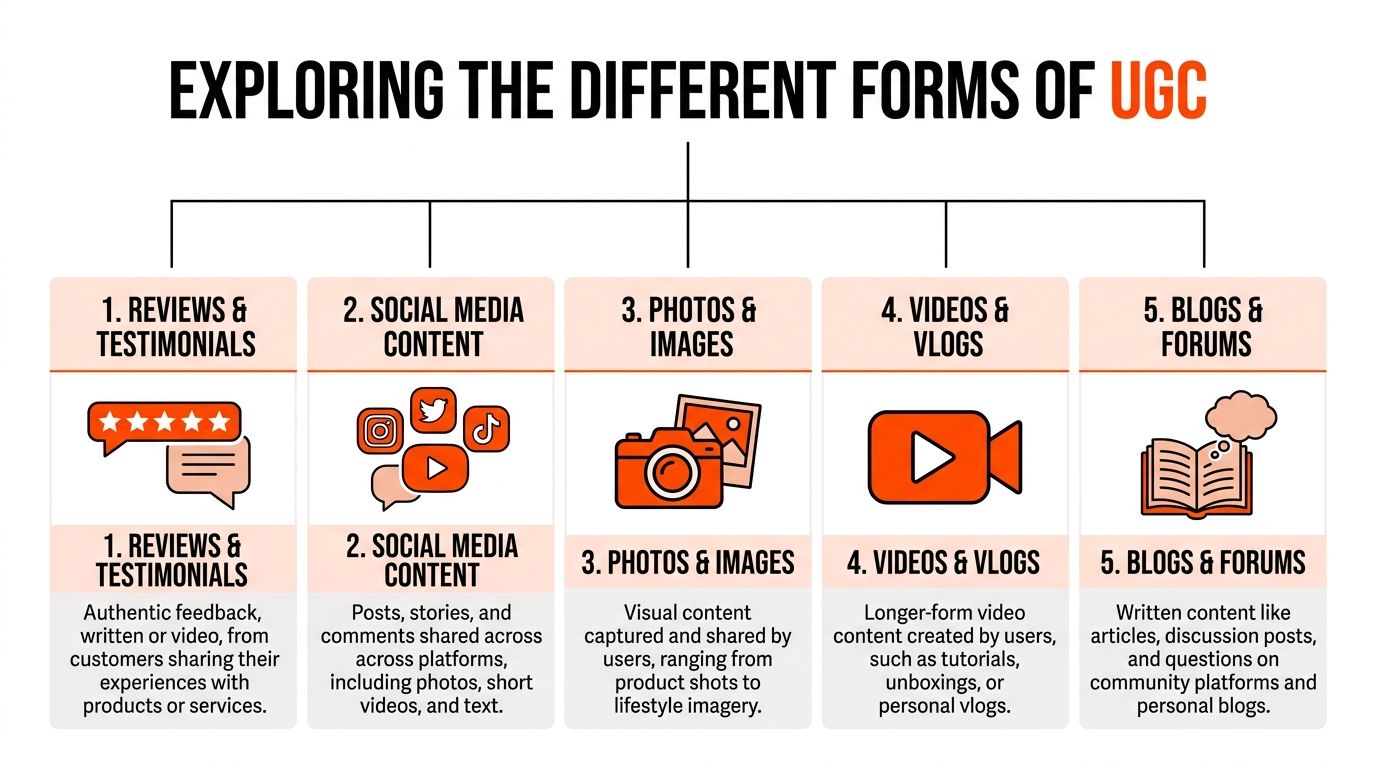
Reviews and testimonials
This is the bedrock. Reviews and testimonials usually carry the clearest buying signal because they speak directly to satisfaction, quality, fit, delivery, or results.
They work best when a buyer is already comparing options.
A beauty brand might use short customer quotes on product pages. A travel brand might feature guest comments about cleanliness, location, or ease of booking. A sports label might surface opinions on comfort, sizing, or durability.
Best use cases:
- Product pages where buyers need reassurance
- Email flows where hesitation is slowing purchase
- Sales decks and retail materials where social proof needs to be concise
Social media posts and Stories
This is the most visible form of UGC. It includes tagged Instagram posts, TikToks, Reels, comments, mentions, and Stories showing a product or experience in context.
Its main strength is immediacy. It shows the brand in motion, inside actual routines.
A café doesn’t need to explain atmosphere if customers keep posting from the window seats. A luggage brand doesn’t need to describe travel-readiness if users keep documenting airport runs and hotel arrivals with the product in frame.
For brands building a stronger visual pipeline, this often overlaps with broader content planning and production. Teams that want to translate these raw moments into more structured assets can look at approaches used in social media video production.
Photos and lifestyle imagery
Photo-led UGC tends to outperform when appearance matters. That makes it especially useful in fashion, interiors, beauty, food, hospitality, and travel.
Unlike polished campaign photography, user images answer practical questions:
- What does it look like in normal lighting?
- How does it fit into a real home, shelf, gym kit, or suitcase?
- Does it still look good without studio styling?
That realism reduces uncertainty.
Practical rule: If the buyer is wondering “what will this look like for someone like me?”, photo UGC is often the fastest answer.
Videos and long-form creator explainers
Video UGC has more room to demonstrate than static content. It can show texture, movement, steps, sequencing, setup, or transformation.
Typical examples include:
- Unboxings that reduce uncertainty before purchase.
- How-tos that show product use in plain language.
- Routine videos that place the product inside daily life.
- Travel recaps or experience reviews that make an offer feel tangible.
Longer formats tend to work well for higher-consideration purchases because they answer more objections.
Blogs, forums, and community discussion
This is quieter but often more persuasive than brands expect. Forum threads, written reviews, subreddit discussions, and blog posts can carry serious weight because they feel less performative than social posts.
A customer explaining why they switched skincare routines, chose one running shoe over another, or booked one destination instead of a competing one can influence buyers who are actively researching.
This format is strongest when the audience is deep in consideration and wants detail, not just aesthetic proof.
The Undeniable Benefits of Embracing UGC
The business case for UGC is no longer theoretical in the UK market. It’s visible in buying behaviour, engagement, and campaign performance.
Customer photos, reviews and creator-style content can help prospective buyers understand how products are used. Their value depends on the audience, placement and execution.

Trust changes the quality of attention
UGC doesn’t just attract views. It changes how people interpret what they see.
A branded asset usually arrives with obvious intent. People know it’s selling. UGC can still support a sale, but it arrives wrapped in lived experience. That lowers resistance. The audience sees use before message.
That’s why UGC often works best near decision points:
- On product pages where proof matters more than polish
- Inside paid social where thumb-stopping visuals need credibility
- In creator whitelisting and amplification where performance depends on relatability
It gives brands a more efficient content engine
Most marketing teams don’t struggle because they have no ideas. They struggle because they need more usable assets, across more channels, at a pace internal production can’t always support.
UGC helps solve that. Not because it replaces professional production, but because it fills gaps branded shoots can’t cover efficiently.
A strong UGC library can support:
| Business need | How UGC helps |
|---|---|
| Paid social testing | Supplies multiple hooks, faces, and environments |
| Email creative | Adds proof without building fresh studio assets |
| Product pages | Shows real use and reduces uncertainty |
| Community building | Gives customers visible ownership in the brand story |
It’s not “free content.” It’s lower-friction content with a different value profile.
Engagement quality improves when people recognise themselves
Branded content often asks audiences to admire. UGC asks them to relate.
That matters because community doesn’t grow from polished distance. It grows when people see someone like them using the product, wearing the shade, visiting the place, or getting the result.
Brands that understand the wider benefits of influencer marketing usually get this quickly. The strongest influencer work and the strongest UGC both rely on recognisable context, not just reach.
What works and what doesn’t
What works:
- Specific experiences, not generic praise
- Visible outcomes, not abstract claims
- Contextual placement, so the right asset appears where the buyer needs it
- A mix of formats, because one review won’t do the work of a tutorial
What doesn’t:
- Treating every tagged post as usable
- Posting low-quality UGC just because it’s authentic
- Assuming engagement equals commercial impact
- Running UGC as a random repost habit instead of a system
UGC performs because it feels credible. Once a brand strips out that credibility through over-editing, poor placement, or weak selection, performance usually softens.
How Leading Brands Win with UGC Campaigns
The best UGC campaigns don’t begin with “let’s collect content.” They begin with a sharper question. What behaviour is the brand trying to trigger, and what kind of customer proof would make that behaviour easier?
That’s why strong campaigns usually have a simple mechanic. A hashtag. A submission prompt. A product moment worth sharing. A clear reason for customers to participate.
Beauty brands win when they show results in ordinary settings
Beauty is one of the strongest UGC categories because buyers want to see products away from campaign lighting. They want bathroom mirror footage, daylight application, skin texture, routine order, and wear-through.
A smart beauty campaign usually invites customers to share one of three things:
- A routine
- A finish
- A result over time
That gives the brand varied assets with real utility. Some pieces work as awareness creative. Others answer objections around texture, shade, or ease of use.
The common mistake is choosing only the most polished submissions. The better approach is choosing the clearest demonstrations of believable use.
Travel brands win when they build aspiration through proof
Travel UGC performs when it balances beauty with specificity. A destination shot alone can create interest, but the more persuasive assets usually add context. Room view. Walkability. Food. Transport. Family suitability. What the beach looked like in normal weather. What the city felt like at night.
That kind of content doesn’t just inspire. It reduces uncertainty.
A travel brand can turn customer posts into:
- Destination recaps for social discovery
- On-site galleries for booking support
- Email features tied to seasonal pushes
- Retargeting creative built from real guest perspective
Strong travel UGC doesn’t just say “go here.” It helps a buyer picture themselves already there.
Sports brands win when the product is shown under real conditions
Sport and fitness buyers are sceptical of idealised performance claims. They want to see the item in use during training, commuting, warm-ups, recovery, or race day.
UGC works here because it places products inside effort, not just aesthetics.
A practical sports UGC campaign often centres on moments like:
- first session in new kit
- race preparation
- post-match recovery
- daily consistency rather than elite performance
That broadens relevance. It tells the audience the brand is for real users, not just peak athletes.
The common mechanics behind winning campaigns
Across categories, successful UGC campaigns usually share the same foundations:
| Campaign element | Why it matters |
|---|---|
| Clear prompt | People need to know what to post |
| Easy discovery method | Hashtags, tags, or submissions reduce friction |
| Smart curation | Not every asset is good enough to reuse |
| Usage plan | UGC should feed paid, organic, web, and CRM |
| Rights and disclosure process | Reuse without process creates risk |
For teams looking at more campaign structures and prompts, this roundup of winning user-generated content campaigns is a helpful source of inspiration.
Building a Successful and Measurable UGC Strategy
A UGC strategy falls apart when it relies on hope. Hope that customers will post. Hope that social managers will find the best assets. Hope that someone can prove value after the campaign ends.
A better system is built backwards from commercial use.
Start with one use case, not every use case
UGC can support a lot of channels, but that doesn’t mean a brand should launch everywhere at once. The first decision is simple. What job should this content do first?
Common starting points include:
- Improve paid social creative
- Strengthen product page proof
- Support influencer amplification
- Reduce the load on internal content production
Once that’s clear, the content ask gets clearer too. A product page programme needs proof and clarity. A paid social programme needs hooks, faces, settings, and variation.
Build the collection process before asking for content
Many brands rush to “post and ask” without deciding how they’ll review, store, permission, tag, and deploy submissions.
That creates clutter.
A workable process needs:
- A collection point such as a branded hashtag, tagged mentions, a form, or post-purchase email.
- A review standard so teams know what qualifies for reuse.
- A rights workflow before anything gets repurposed.
- A tagging system by product, audience, theme, and format.
Without that structure, UGC becomes hard to search and even harder to scale.
Measure beyond likes
Many UGC programmes get exposed at this point. Engagement looks good, screenshots circulate, everyone says the campaign “felt strong,” but no one can tie content to commercial value.
UGC can attract attention while still being difficult to connect to sales. Track what people do next, such as site visits, enquiries and purchases, before drawing conclusions about commercial performance.
That gap matters. UGC can create attention and still be under-measured.
The fix is operational, not philosophical.
What to track
- Asset-level performance by format, creator type, hook, and placement
- Click and conversion behaviour when UGC appears in paid or on-site experiences
- Assisted influence across journeys, especially in travel and higher-consideration categories
- Zero-party signals such as stated preferences, quiz responses, and declared intent
What to stop doing
- Reporting all UGC together as one bucket
- Using reach as a proxy for value
- Ignoring landing page behaviour after a strong social result
- Treating screenshots of comments as proof of ROI
If a team can’t say which UGC assets moved which audience segment closer to purchase, it doesn’t have a strategy yet. It has activity.
Repurpose with intent
Once high-performing assets are identified, they should move into a planned distribution cycle. One useful customer review might become a product page quote, an an email tile, a Story frame, and a paid social variant. One tutorial video might become a full cut, a short paid edit, and a website explainer.
The key is matching format to function. Not every good post belongs everywhere.
Staying Compliant with UK UGC Regulations
UGC is often described as cheap, easy, and authentic. That framing leaves out the hard part. Once a brand starts encouraging, rewarding, selecting, or amplifying customer content, compliance enters the room.
In the UK, that means brands can’t treat UGC as a legal free-for-all.
The risk behind the repost
A repost can look harmless. But if there’s payment, gifting, a free stay, a discount, affiliate value, or any other incentive connected to the content, disclosure rules matter. The content may still feel organic to the audience, but regulators won’t assess it on vibes.
That’s where teams get caught. The marketing side sees “community content.” The ASA may see an ad that hasn’t been labelled clearly enough.
Brands need to assess when incentivised creator content counts as advertising, follow applicable ASA rules and ensure that required disclosures are clear.
What brands need to do in practice
Compliance doesn’t need to kill performance. It needs process.
A safer operational standard includes:
- Check the relationship. If value changed hands, treat disclosure seriously.
- Use clear labelling. If content is advertising, ambiguity is the problem.
- Document permissions and usage rights. Consent to repost and permission to use in ads aren’t always the same thing.
- Brief creators and community managers together. Many compliance failures happen between teams, not inside one team.
Brands dealing with product seeding and creator incentives should also understand the practical side of influencer gifting laws.
The trade-off often underestimated
Some marketers still assume clearer disclosure will weaken performance. In practice, poor disclosure usually does more damage because it creates a trust problem on top of a regulatory one.
A well-run UGC programme protects three things at once:
| Area | What good compliance protects |
|---|---|
| Brand reputation | Prevents audience backlash over hidden commercial ties |
| Creator relationships | Reduces confusion and post-publication disputes |
| Campaign value | Keeps strong content usable across channels without avoidable risk |
The strongest UGC programmes in the UK aren’t the loosest. They’re the most organised.
Colossal Influence helps brands, PR teams, and creators build influencer and UGC programmes that are commercially strong, measurable, and compliant with UK market realities. For support with creator strategy, campaign execution, and partnership structure, visit Colossal Influence.
Follow us on Social Media


