

A social media influencer campaign can generate attention quickly. The harder question is simpler and more uncomfortable. Did people remember the brand after they saw it?
Many teams still answer that question with likes, reach screenshots, and a creator’s follower count. Those numbers have a place, but they do not prove awareness on their own. Awareness sits higher up the funnel. It lives in memory, recognition, recall, conversation quality, and the ability to create a larger pool of future buyers.
Why Measuring Influencer-Driven Brand Awareness Matters
The industry does not have a usage problem. It has a proof problem.
Marketers can usually show that content went live and that people interacted with it. They struggle to show whether a social media influencer changed how a target audience thinks about the brand. That gap matters most when budgets tighten, procurement asks harder questions, or a client wants to know why influencer spend should continue when paid media already reports neat dashboard numbers.

One reason this remains messy is the lack of UK-specific benchmarks. There is a documented content gap around localised micro-influencer performance data, including expected CPMs, engagement thresholds, and conversion metrics for British audiences, which makes ROI justification harder for UK marketing directors planning campaigns (Afluencer).
Vanity metrics create false confidence
A post can pull in visible engagement and still do very little for brand memory.
That happens when:
- The creator fit is wrong. The audience interacts with the influencer, not the brand.
- The content is entertaining but vague. Viewers remember the joke, not the product.
- Reporting stops at platform analytics. Teams measure exposure but never test recall or perception.
- One-off activations distort judgment. Short bursts can look busy without building any lasting mental availability.
A more disciplined approach treats awareness as a measurable business outcome. It combines platform data with traffic signals, qualitative review, and survey work. Marketers already familiar with broader social media ROI models will recognise the same principle. Output metrics matter, but they need to connect to business meaning.
Awareness measurement improves decisions before the next brief
Value lies not just in post-campaign reporting. It is better planning.
A proper awareness framework helps teams decide:
- Which creator tier fits the job
- Which formats deserve more budget
- Whether branded messaging is landing clearly
- When awareness is improving but consideration is not
- Which creators should move into always-on relationships
For brands weighing whether creator marketing deserves a larger role, the commercial case becomes easier to defend when awareness is measured systematically rather than assumed. That is also why many marketers start by understanding why influencer marketing works before they build a reporting model.
Key takeaway: Awareness is not a soft metric. It becomes soft only when teams fail to define how they will observe it.
Laying the Groundwork for Meaningful Measurement
Awareness campaigns fail in the planning stage more often than in reporting. If the brief is vague, the measurement will be vague as well.
“Increase awareness” is not a workable objective. It gives the creator no sharp message to communicate, and it gives the marketing team no reliable basis for judging success. A measurable awareness objective needs a specific audience, a specific market, and a specific signal that will indicate progress.
Start with a measurable awareness brief
A strong brief answers four questions before outreach begins.
Who needs to know the brand exists
This should be a clear segment, not “everyone on Instagram”. A beauty launch aimed at women in the UK has very different creator requirements from a travel offer aimed at frequent city-break planners.
What should they remember
The brand name alone is not enough. The campaign should prioritise one memory structure, such as a category association, a use case, or a distinct benefit.
Where will awareness show up
Some campaigns need broader cultural visibility. Others need branded search interest, direct traffic from creator links, or uplift in branded mentions.
How long should the effect last
If the campaign is only judged in the first few days, the team may reward short-lived spikes instead of stronger memory-building content.
Choose creators based on audience quality, not just profile size
Follower count is still the easiest trap in influencer planning.
For UK beauty and fashion work, one documented methodology recommends micro-influencers in the 10k to 100k follower range, verifying 70 to 80% authentic UK-based followers, keeping fake follower levels below the stated threshold, and looking for strong demographic overlap with the target audience. The same methodology recommends targeting 3 to 6% engagement rates on Instagram Reels and Stories, with a cost-per-engagement of £0.02 to £0.06, described as 5 to 10 times lower than paid ads (Hashmeta).
That matters because awareness campaigns need credible exposure. Inflated audiences make awareness reporting look healthier than it is.
A practical vetting stack often includes:
- HypeAuditor for audience authenticity checks
- SocialBlade for growth pattern review
- Native platform insights for location, age, and gender alignment
- UTM tracking built into every live asset that can carry a link
Marketers evaluating creators can also use a structured sourcing process rather than relying on ad hoc discovery through feeds. This guide on how to find influencers is useful when building a repeatable shortlist process.
Build the measurement plan into the contract
Too many teams leave measurement to the reporting deck. By then, the campaign has already limited what can be observed.
The contract or campaign scope should settle:
- Required content formats
- Disclosure and approval rules
- What links, codes, or landing pages must be used
- What screenshots or exports the creator must provide
- Whether the brand can run brand lift surveys against exposed audiences
- Whether usage rights allow reposting for additional reach analysis
Practical tip: If a metric is not operationalised before posting starts, it usually disappears from the final report.
Awareness becomes easier to measure when creator selection, message design, link structure, and reporting obligations are decided together. Without that groundwork, teams are left trying to infer brand impact from whatever numbers happen to be available after launch.
Decoding Quantitative Brand Awareness Metrics
The first dashboard most brands build is usually the wrong one. It overweights visible interaction and underweights breadth, repetition, and traffic quality.
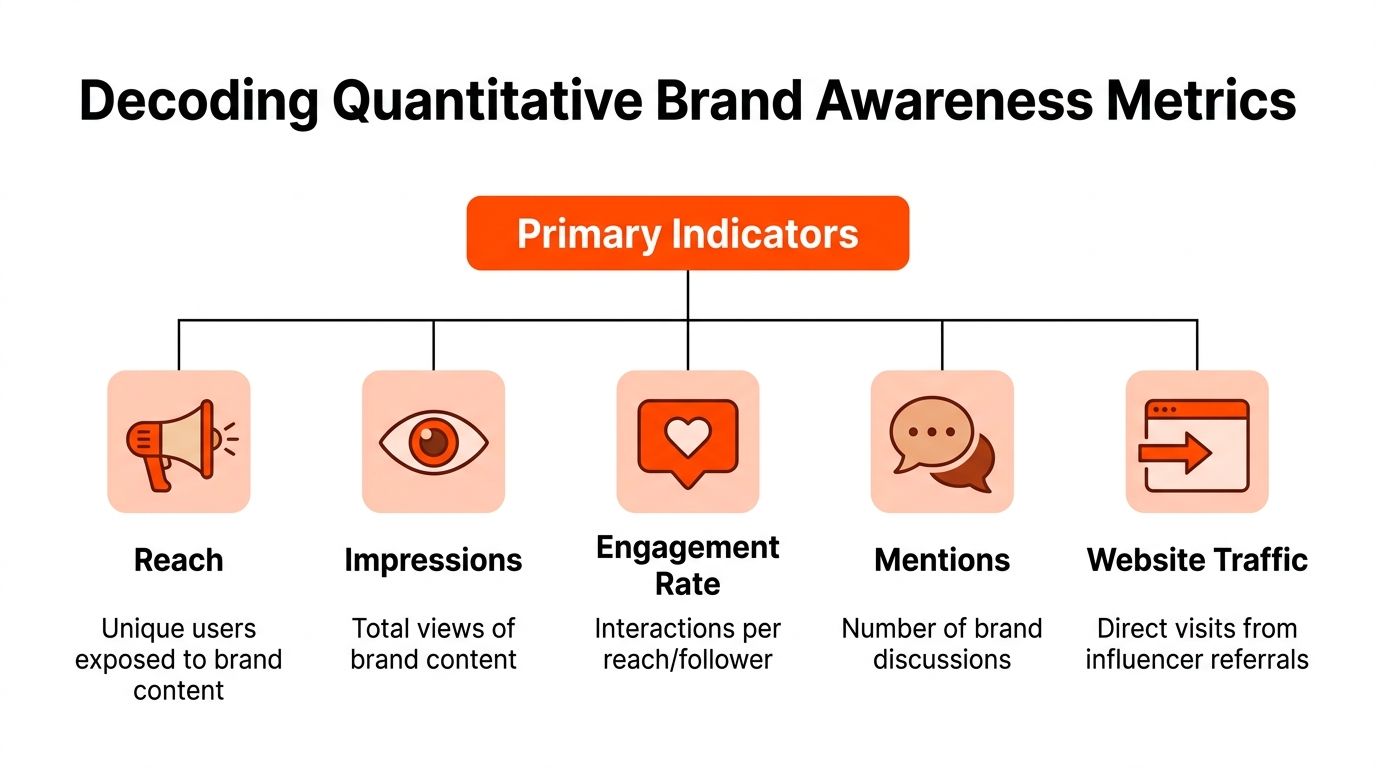
For awareness, a social media influencer campaign should be judged on a set of primary indicators that work together. No single metric can carry the full story.
Reach and impressions are not interchangeable
Reach shows how many unique users were exposed to the content. Impressions show how many total times the content was viewed.
Both matter, but they answer different questions:
- Reach asks how wide the message travelled
- Impressions ask how often the market had the chance to notice it
If impressions rise much faster than reach, the campaign may be leaning heavily on repetition within the same audience pocket. That can be useful for recall, but it can also signal poor expansion into new audiences.
Engagement rate is a quality signal, not the objective itself
Engagement is helpful because it tells the team whether people did more than passively scroll. It becomes misleading when treated as the end goal.
The UK market remains active enough that format choice matters a great deal. In 2025, the UK ranked fourth globally for Instagram influencer engagements with 74.1 million total interactions, and marketers looking for stronger visibility should prioritise formats with the highest engagement, including carousels at 1.36% and Reels at 1.24% (Sprout Social).
That does not mean every campaign should default to the same asset mix. It means awareness reporting should break out performance by format, because a carousel that explains a product clearly may build stronger recognition than a slick short video that attracts attention without communicating much.
The metrics that belong on an awareness dashboard
A practical awareness dashboard usually includes the following:
Reach by creator and by format
This shows where unique exposure is really coming from.Impressions and frequency pattern
Repeated exposure can support brand memory, but over-concentration can waste budget.Engagement rate
Useful as a proxy for resonance. Best viewed alongside reach, not in isolation.Mentions and tagged conversations
These help identify whether people are discussing the brand beyond the sponsored post itself.Website traffic from influencer referrals
Awareness campaigns still create action. Referral sessions often reveal whether curiosity translated into behaviour.Audience growth on owned brand channels
This does not prove awareness alone, but it can show whether creator activity caused people to seek out the brand directly.
What not to overvalue
Some metrics should be treated carefully.
| Metric | Why teams overvalue it | Better interpretation |
|---|---|---|
| Likes | Easy to screenshot and compare | Use as a light engagement signal only |
| Follower count | Looks impressive in decks | Compare against audience fit and post-level performance |
| Video views | Can appear large quickly | Check completion quality and downstream actions |
| CPM alone | Useful for efficiency | Pair with brand fit and qualitative response |
Read the numbers in context
A useful quantitative review asks harder questions than “which creator got the most engagement?”
It asks:
- Did larger creators expand unique reach, or just add cost?
- Did the best-performing format also communicate the brand clearly?
- Did referral traffic align with the audience the brand wanted to reach?
- Did awareness indicators improve across more than one creator, or was the result carried by a single outlier?
There is also a category difference to respect. Beauty and fashion can often generate stronger visible interaction around tutorials and styling formats. Other sectors may show awareness more clearly in traffic quality, search interest, or branded mention patterns.
For teams still new to creator reporting, a grounding in what is influencer marketing helps separate creator-led awareness metrics from the metrics more common in paid social or affiliate programmes.
Key takeaway: Quantitative data should show both breadth and response. If the dashboard only reports interaction, it is incomplete.
Unlocking Insights with Qualitative Analysis
Numbers reveal scale. They do not reveal meaning.
A campaign can generate healthy reach and acceptable engagement while still damaging perception, confusing the message, or attracting the wrong kind of attention. That is why qualitative analysis belongs in any serious awareness model. It shows how people are interpreting the brand after exposure.
Start with comment quality, not just comment volume
Comment counts are easy to collect. Comment meaning takes work.
A useful review looks at:
Message recall
Are people repeating the right product, offer, or use case?Perception shift
Do comments suggest the brand feels more premium, more accessible, more credible, or more relevant?Intent signals
Are users asking where to buy, how it works, whether it is available in the UK, or whether others recommend it?Confusion
Do audiences understand that the post is sponsored? Do they understand what the brand does?
Three hundred comments saying “love this creator” do less for awareness than twenty comments accurately repeating the product proposition.
The authenticity question cannot be ignored
Brands often treat authenticity as a creative preference. It is closer to a measurement variable.
The documented “authenticity paradox” points to the disconnect between a creator’s curated image and reality, and highlights the need for UK brands to assess genuine audience trust, especially as ASA scrutiny around misleading claims links authenticity directly to ROI and legal exposure (Upworthy).
This changes how a marketer should assess a social media influencer. The issue is not whether the creator is polished. The issue is whether the audience still treats that creator as believable.
A practical authenticity review should include:
Consistency
Does the brand fit naturally with the creator’s usual content and values?Audience reaction
Do followers welcome the partnership, ignore it, or push back against it?Disclosure behaviour
Sponsored content should be clearly labelled. Ambiguity undermines trust and creates compliance risk.Conversation pattern
Are followers discussing the product itself, or treating the post as another interchangeable ad?
Build a simple coding framework
Qualitative analysis becomes far more useful when the team codes responses consistently.
| Theme to code | What to look for | Why it matters for awareness |
|---|---|---|
| Brand recall | Correct naming of the brand or product | Shows whether the message stuck |
| Sentiment | Positive, neutral, sceptical, negative | Indicates emotional direction |
| Relevance | Comments linking the product to a real need | Signals resonance with the audience |
| Credibility | Trust in creator recommendation | Helps explain why some posts convert awareness better |
| Confusion | Misunderstandings about product or offer | Flags weak creative or poor briefing |
This can be done manually for smaller campaigns or supported with social listening tools for larger ones. Either way, the important point is consistency. Without a coding framework, qualitative review turns into anecdotal cherry-picking.
Look beyond the sponsored post
Useful awareness signals often appear outside the post itself.
Teams should also review:
- Unprompted brand mentions after the campaign
- Creator audience DMs or saved FAQs shared back to the brand
- Community language that repeats the campaign message
- Reposts or creator follow-on content that audiences continue discussing
Broader engagement strategy starts to matter here. Brands that understand social media engagement strategies tend to get more value from creator commentary because they are prepared to respond, repost, and extend the conversation rather than observe it.
Practical tip: If qualitative review is skipped, teams often misread attention as trust. Those are not the same thing.
How to Design Surveys That Measure Brand Lift
If platform metrics show exposure and qualitative analysis shows interpretation, surveys show something harder to capture through observation alone. They show whether awareness changed in people’s minds.
That makes brand lift studies one of the most useful tools in influencer measurement. They are also underused because many teams assume they are complicated or only suitable for very large budgets. In practice, the method is straightforward when the survey is designed properly.
Use exposed and control groups
The basic principle is comparison.
One group has been exposed to the influencer content. The other has not. When both groups match the target audience closely enough, the difference between their answers gives the brand a more reliable view of campaign impact.
In UK sports and travel, influencers average a 1.6% engagement rate, and brands using trackable links in content can measure direct impact with 1 to 3% booking rates. That is useful when setting realistic expectations for awareness studies because it links upper-funnel activity to commercial outcomes rather than treating awareness as detached from bookings (IQfluence).
Ask questions that reflect the awareness funnel
A survey should move from memory to perception, then towards intent. A clean structure usually includes the following.
Unaided awareness
Ask respondents which brands come to mind in the category without prompting them.
This is the toughest awareness test and often the most valuable. If the campaign has shifted mental availability, the exposed group should be more likely to recall the brand on their own.
Aided awareness
Show a short list of brands and ask which ones respondents recognise.
This is easier than unaided recall and works well when the brand is newer or entering a crowded market.
Message association
Ask which statements respondents connect with the brand.
This identifies whether people remember the right thing, not just the name. A campaign can increase recognition while failing to land the intended product story.
Perception and consideration
Use a small set of attitudinal statements that reflect the brand’s desired position.
Examples include whether the brand feels relevant, trustworthy, premium, useful, or worth exploring. The exact wording should match the campaign brief and category.
Keep the questionnaire disciplined
Awareness studies fail when teams try to answer every business question in one survey.
A cleaner questionnaire follows a few rules:
- Keep the wording simple. Avoid internal brand language.
- Do not lead the respondent. Neutral phrasing matters.
- Use the same questions for both groups.
- Limit survey length. Shorter surveys produce cleaner answers.
- Tag responses clearly by audience segment. Regional or demographic cuts often explain why lift appears uneven.
A practical starting point is to adapt a structured questionnaire rather than drafting from a blank page. This Brand Awareness Survey Template is a useful reference for organising recall, perception, and intent questions in one flow.
Tie survey results back to campaign activity
Survey findings become more valuable when mapped against actual campaign variables.
For example:
- Did the creator with the strongest qualitative credibility also produce the strongest aided recall?
- Did clearer product demos produce stronger message association than lifestyle-led content?
- Did referral traffic align with the audience the brand wanted to reach?
- Did awareness indicators improve across more than one creator, or was the result carried by a single outlier?
Those are strategic decisions, not reporting trivia.
Common design mistakes
| Mistake | What it causes | Better approach |
|---|---|---|
| Surveying only exposed users | No baseline for comparison | Use a matched control group |
| Asking vague “did you like this?” questions | Weak strategic value | Focus on recall, perception, and association |
| Running the survey too late | Memory decay muddies results | Field close enough to exposure to capture effect |
| Ignoring segmentation | Averages hide useful patterns | Split by audience type, region, or creator cluster |
Key takeaway: Brand lift surveys work best when they answer one sharp business question well, rather than many questions poorly.
Choosing Your Toolkit for Awareness Measurement
Measurement quality depends partly on method and partly on tooling. The best framework still breaks down if the team cannot collect clean data, compare sources, or interpret signals consistently.
Most brands do not need a huge stack. They need a sensible one. For influencer-driven awareness, the toolkit usually falls into three broad categories: social listening, web analytics, and survey platforms. A fourth layer often sits over the top in the form of creator discovery and campaign management software.
Match tools to the job they perform
Different tools answer different questions.
- Social listening platforms help track brand mentions, sentiment patterns, keyword themes, and conversation spread.
- Web analytics platforms show what happened when users moved from creator content to owned brand properties.
- Survey tools measure recall, recognition, and perception shifts that platform analytics cannot see.
- Influencer platforms help with creator vetting, reporting workflows, link governance, and asset tracking.
Problems start when teams ask one tool to solve everything. Google Analytics cannot measure brand recall. A survey platform cannot tell the team whether an influencer’s audience is full of low-quality followers. A social listening tool cannot replace campaign tagging discipline.
Essential Toolkit for Measuring Influencer-Driven Brand Awareness
| Tool Category | Primary Function for Brand Awareness | Example Platforms |
|---|---|---|
| Social listening | Track mentions, sentiment themes, and post-campaign conversation patterns | Brandwatch, Meltwater, Talkwalker |
| Web analytics | Measure referral traffic, landing-page behaviour, and influencer-tagged sessions | Google Analytics |
| Survey tools | Run brand lift studies, exposed versus control comparisons, and perception surveys | Typeform, SurveyMonkey, Formbot |
| Influencer analytics and vetting | Review audience authenticity, demographics, and creator performance history | HypeAuditor, SocialBlade |
| Campaign management and consultancy | Coordinate creator selection, reporting inputs, and campaign structure | Colossal Influence |
What to prioritise if budget is limited
Smaller teams do not need to buy every platform at once.
A lean stack can still be effective:
- Google Analytics for referral and landing-page analysis
- A survey tool for recall and perception checks
- One creator vetting tool such as HypeAuditor or SocialBlade
- Native platform reporting exported consistently by creator and format
That setup will not produce enterprise-grade social listening, but it covers a large share of what matters for awareness decisions.
What enterprise teams usually need
Larger brands, group agencies, and multi-market teams need stronger governance.
They often benefit from:
- Listening platforms with historical mention tracking
- Standardised naming conventions for creator links and campaign tags
- Dashboards that combine platform data with site behaviour
- Survey systems that support audience segmentation and repeat studies
- Internal review processes for compliance and disclosure checks
The main trade-off is speed versus rigour. Richer stacks provide cleaner insight, but they also demand disciplined implementation. Without consistent tagging, naming, and reporting ownership, more software creates more fragmented data.
How to choose without overbuying
A sensible selection process asks a short set of practical questions.
| Question | Why it matters |
|---|---|
| Can the tool separate creator-level performance clearly? | Awareness analysis often depends on comparing creators, not just campaign totals |
| Does it integrate with existing analytics or exports cleanly? | Manual reconciliation creates reporting delays and errors |
| Can non-technical teams use it? | If strategists and account managers cannot access the data, adoption drops |
| Does it support qualitative review, not just hard metrics? | Awareness needs meaning, not only counts |
The right toolkit is rarely the most complex one. It is the one the team can operate repeatedly, without improvising a new reporting process on every campaign.
Bringing It All Together An Integrated Measurement Strategy
Awareness measurement works when it stops being treated as a single report at the end of a campaign.
A stronger model treats each campaign as one cycle in a broader learning system. The brand sets a clear awareness objective, selects creators against that objective, tracks quantitative exposure, studies qualitative response, and validates mental impact through survey work. Then it feeds those findings back into the next brief.
The integrated model in practice
A useful operating rhythm looks like this:
Before launch
Define the audience, the memory goal, the creator selection rules, the links, and the survey plan.During the campaign
Monitor reach, impressions, engagement patterns, mentions, traffic, and disclosure quality.Immediately after launch
Review comments, code sentiment and message recall, and compare creator outputs against the brief.Post-campaign
Run the brand lift analysis, compare exposed and control responses, and connect perception shifts to format and creator variables.Planning for the next cycle
Keep the creators, messages, and formats that built real awareness. Cut the ones that generated noise without memory or relevance.
Many brands improve sharply at this stage. They stop asking which creator was “popular” and start asking which creator changed audience perception in a useful way.
Awareness should influence future buying decisions
A mature measurement approach changes more than reporting language.
It should shape:
- Creator tier selection
- Briefing quality
- Platform mix
- Format mix
- Always-on versus one-off activation choices
- How brand and performance budgets work together
That matters because awareness is not isolated from commercial outcomes. It sits upstream of them. Better awareness usually shows up first in memory, recognition, traffic curiosity, and stronger conversation quality before it appears in harder sales metrics.
A practical checklist for marketing teams
Before approving any social media influencer awareness campaign, teams should be able to answer yes to the following:
- Is the target audience defined clearly enough to measure exposure quality?
- Is the core message narrow enough that recall can be tested?
- Have creators been vetted for audience fit and credibility?
- Are links, tags, and landing pages prepared before posting starts?
- Does the reporting plan include both quantitative and qualitative review?
- Will the campaign run a survey or another structured recall method?
- Is there a decision framework for what happens after the results come in?
Final takeaway: The best awareness framework does not chase one perfect metric. It combines several imperfect but useful signals into a decision-ready picture.
When that picture is built properly, influencer marketing becomes easier to defend, easier to optimise, and far less dependent on vanity metrics that flatter the campaign without helping the brand.
Brands that need support building that measurement system can work with Colossal Influence on influencer strategy, creator selection, campaign structure, and reporting design so awareness is measured with the same discipline as any other marketing investment.
Follow us on Social Media


