

Finding the perfect moment to publish your YouTube video can feel like a guessing game. Post too early, and you miss your audience; post too late, and you get lost in the noise. The truth is, the best time to post to YouTube isn't a single magic hour. It's a sophisticated strategy that balances universal peak times with your unique audience's behaviour and viewing habits.
The initial performance of your video heavily influences its long-term success. YouTube's algorithm rewards videos that gain immediate traction with views, likes, comments, and watch time by promoting them to a wider audience. Nailing your upload schedule is the first step to triggering this positive feedback loop and securing a prominent place on viewers' homepages.
This article breaks down seven data-driven strategies, moving beyond generic advice to provide actionable timings and specific approaches. Whether you're targeting a global audience or a specific niche, these insights will help you schedule your content for maximum impact. While timing is crucial, remember to integrate it with other broader best practices for YouTube content creation and optimisation to truly maximise your reach. We will explore how to turn timing into your channel's most powerful competitive advantage.
1. Post During Peak Traffic Hours (2-4 PM EST)
One of the most widely recognised strategies for determining the best time to post to YouTube is to target the global peak traffic window. This period, generally accepted to be between 2 PM and 4 PM Eastern Standard Time (EST), represents a strategic intersection of viewing habits across different continents.
By publishing during this timeframe, creators can simultaneously capture audiences in North America during their afternoon downtime and viewers in Europe winding down for the evening. This overlap maximises the potential for immediate views and engagement, which are critical signals for YouTube's algorithm. A strong initial performance can significantly boost a video's visibility, increasing its chances of being recommended to a wider audience.
Why This Window is So Effective
The logic behind this approach is rooted in capitalising on high-volume user activity. When a video goes live, the first few hours are crucial. A surge of views, likes, comments, and shares tells the algorithm that the content is valuable and engaging.
- North American Audience: Viewers in this region are often on a break from school or work, scrolling through their subscriptions on mobile devices.
- European Audience: This window aligns with prime evening viewing hours in Europe, when people are more likely to settle in for longer-form content.
This strategy has been a cornerstone for major creators. For instance, global sensation MrBeast frequently schedules his uploads around 3 PM EST, consistently achieving millions of views within the first few hours. This initial momentum is a key factor in his content's viral success.
Key Takeaways for Peak Hour Posting
For a quick reference, the following summary box highlights the essential data points for this strategy.
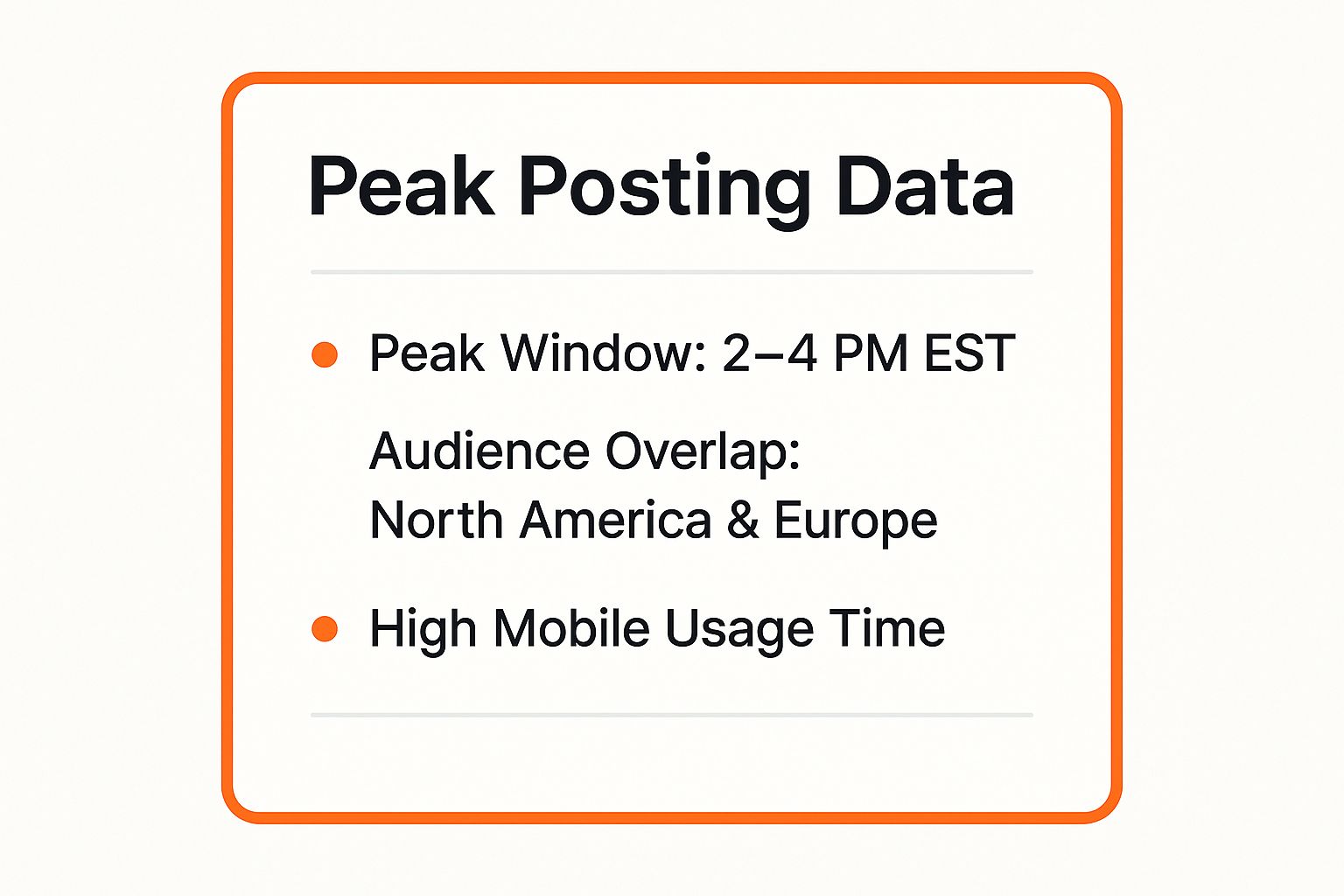
As the infographic illustrates, the core principle is to leverage the convergence of major audiences and high mobile usage to give your video the strongest possible start. You can explore a deeper analysis of these audience overlaps and find more details about why this is the best time to upload to YouTube by checking out other expert resources. To gain a broader perspective, you can learn more about YouTube upload times on colossalinfluence.com.
2. Leverage Weekend Prime Time (Saturday 9-11 AM EST)
While weekday afternoons capture a broad audience, another powerful strategy for determining the best time to post to YouTube is to target weekend prime time. The window between Saturday 9 AM and 11 AM EST is particularly effective, as it catches audiences when they have more leisure time and fewer weekday distractions.

This slot is ideal for longer-form content that viewers can settle into, such as deep-dive tutorials, lifestyle vlogs, and entertainment series. By publishing during these morning hours, you cater to viewers waking up in North America and catch European audiences in their early afternoon, capitalising on a relaxed viewing mindset that encourages higher watch times and session durations.
Why This Window is So Effective
The success of this strategy is rooted in audience behaviour. Weekends are when people actively seek out content to enjoy, rather than fitting it into short breaks. This leads to deeper engagement and a higher likelihood of viewers watching multiple videos from the same creator.
- Relaxed Viewing: Audiences are not rushing between tasks and are more inclined to watch longer videos in their entirety.
- Prime for Hobbies & Entertainment: This window aligns perfectly with content related to DIY projects, gaming, lifestyle, and education, which people often pursue during their downtime.
- Less Competition: While still a popular time, it can be less saturated than the absolute peak weekday slots, giving quality content a better chance to stand out.
This approach has been a staple for many genres. Gaming channels like Markiplier often see a significant spike in engagement on weekend uploads, while DIY and lifestyle creators frequently report that their weekend posts see far higher interaction rates. The relaxed viewing environment of a Saturday morning provides a prime opportunity for creators to connect more deeply with their audience.
Key Takeaways for Weekend Posting
To maximise your weekend uploads, focus on content that complements a leisurely viewing experience. This is the perfect time for evergreen videos that don't rely on immediate, time-sensitive relevance.
You can also build anticipation by promoting your upcoming Saturday video throughout the week. For those looking to understand how timing and audience engagement intersect in broader campaigns, you can explore the benefits of influencer marketing and prime timing on colossalinfluence.com. This timing strategy helps build a loyal viewership that eagerly awaits your weekend content drops.
3. Target Your Audience's Geographic Prime Time
While global peak hours offer a broad strategy, a more refined approach is to analyse your specific audience demographics and post when they are most active. This method moves beyond generalisations to pinpoint the best time to post to YouTube for your unique community, making it one of the most effective data-driven tactics available.
By leveraging YouTube Analytics, creators can access detailed geographic data about their viewership. This information allows you to identify your top audience locations and tailor your posting schedule to their local prime-time viewing hours. This hyper-targeted approach ensures your content goes live precisely when your most engaged viewers are online, maximising immediate interaction.
Why This Customised Approach is So Effective
The power of this strategy lies in its precision. Instead of hoping to catch a global wave, you are directly serving your core audience during their peak leisure time. This deepens community engagement and signals to the algorithm that your content strongly resonates with a specific niche.
- Indian Tech Channels: Often post between 8 PM and 9 PM IST to capture the large local audience after their evening meal.
- UK-focused Lifestyle Vloggers: Frequently schedule uploads for 7 PM to 8 PM GMT, aligning with post-work relaxation and prime-time television hours.
- Australian Gaming Creators: Tend to post around 6 PM to 7 PM AEST, catching viewers as they settle in for dinner and evening entertainment.
This creator-centric approach is widely championed by regional influencers and supported by findings from organisations like Social Media Examiner, which emphasise the importance of audience-specific data over one-size-fits-all advice.
Key Takeaways for Geographic Targeting
To implement this strategy, focus on a systematic review of your analytics and consistent testing. Your goal is to find the sweet spot for your most significant audience segments.
- Analyse Your Data: Regularly review the "Audience" tab in YouTube Analytics to identify your top three countries by viewership.
- Test Posting Times: Schedule posts to coincide with the evening prime time (e.g., 7 PM to 9 PM local time) for each of your top locations and measure the initial performance.
- Consider Cultural Habits: Factor in regional nuances like typical work schedules, public holidays, and meal times that influence viewing patterns.
- Use Scheduling Tools: Maintain a consistent posting schedule across different time zones by using YouTube's built-in scheduling feature.
By aligning your upload schedule with the daily routines of your primary audience, you can foster a more loyal following and significantly improve your video's initial performance metrics.
4. Post Consistently on the Same Day and Time
While pinpointing the perfect hour is a powerful tactic, one of the most impactful strategies for determining the best time to post to YouTube is to establish a predictable schedule. Consistency trains your audience to anticipate your content, transforming passive viewers into a loyal community that shows up for every new upload. This approach often proves more effective than chasing fleeting peak hours.
By publishing at the same day and time each week, you build a powerful habit among your subscribers. This reliability sends positive signals to YouTube's algorithm, which favours channels with a consistent output pattern. An established routine helps the algorithm better understand your content cadence, potentially leading to more consistent promotion and visibility in recommendations.

Why Consistency Builds Momentum
The core principle of this strategy is rooted in audience conditioning and algorithmic favour. A regular schedule minimises the guesswork for your viewers and gives the platform a clear pattern to analyse, which can significantly boost your initial engagement metrics when a video goes live.
- Builds Audience Habits: Viewers know when to look for your new content, creating an appointment-viewing culture around your channel.
- Improves Algorithmic Promotion: A consistent upload history demonstrates channel health and reliability to YouTube, which can improve your content's reach.
This method has been the bedrock for countless successful creators. For example, MKBHD built his tech empire by consistently releasing reviews on Tuesdays and Fridays, while the Kurzgesagt team creates immense anticipation for their meticulously planned monthly uploads. This level of predictability cultivates a dedicated and engaged viewership.
Key Takeaways for Consistent Posting
The following summary box highlights the essential advice for implementing a consistent schedule that works for you and your audience.
As the infographic illustrates, the goal is to create a sustainable and predictable content rhythm that aligns with your audience's expectations. This method is a core component of many long-term growth plans. To delve deeper into how consistency fuels audience interaction, you can explore other expert resources. You can learn more about YouTube engagement on colossalinfluence.com.
5. Avoid Platform Competition Times
A highly strategic yet often overlooked approach to identifying the best time to post to YouTube is to consider what is happening outside of the platform. This means intentionally avoiding periods when your target audience's attention is captured by major events or competing entertainment platforms.
Publishing your video during the Super Bowl, the season finale of a hit Netflix series, or a major national holiday is like trying to open a shop during a city-wide parade happening on another street. Even if your content is excellent, the potential audience is simply preoccupied. By scheduling your uploads to avoid these high-competition slots, you give your content a better chance to be seen without having to fight for attention against massive cultural moments.
Why This Window is So Effective
The core principle of this strategy is attention scarcity. Your viewers have a finite amount of time for entertainment, and major events consume a significant portion of it. By sidestepping these moments, you target periods when your audience is actively seeking new content rather than being passively entertained elsewhere.
- Reduced Attention Split: Viewers aren’t torn between your video and a live sporting event or a highly anticipated film release.
- Algorithmic Advantage: By posting when viewership isn't fragmented, you can consolidate initial engagement, sending stronger positive signals to the YouTube algorithm.
This is a core tenet of media planning, adapted for the digital age. Smart digital marketers and creators recognise that their competition isn't just other YouTubers; it's every other form of media vying for their audience's screen time. Avoiding a Friday 8 PM upload, a common release time for major streaming services like Netflix, can prevent your video from being immediately overshadowed.
Key Takeaways for Avoiding Competition
To implement this, you must become aware of the broader entertainment and cultural calendar that affects your audience.
- Monitor Release Schedules: Keep an eye on release dates for major streaming services, blockbuster films, and highly anticipated video games.
- Track Major Events: Be aware of significant sporting events (World Cup, Olympics), award shows (the Oscars), and major tech announcements (new iPhone launch).
- Plan Around Holidays: Avoid posting on major holidays when people are more likely to be spending time with family and away from their devices.
By thinking like a media planner, you can find quiet pockets in the digital landscape, allowing your content to stand out and capture the undivided attention of your viewers. This proactive scheduling is a sophisticated way to optimise your reach and determine the best time to post to YouTube for your specific channel.
6. Optimize for Mobile Peak Usage Times
With YouTube confirming that over 70% of watch time originates from mobile devices, aligning your posting schedule with peak mobile usage is a powerful strategy. Understanding when your audience is most likely scrolling on their phones offers a direct route to their attention, making this one of the best times to post to YouTube for immediate impact.

This approach moves beyond broad desktop viewing patterns to focus on specific, mobile-centric windows of opportunity. By publishing content when viewers are commuting, on a lunch break, or relaxing in the evening, you can capture their undivided attention during moments they dedicate to their mobile devices.
Why This Window is So Effective
The logic here is to meet your audience where they are, when they are most receptive. Unlike desktop viewing which is often scheduled, mobile viewing is more spontaneous and integrated into daily routines. A video that goes live duringこれらの key moments can achieve significant initial traction.
- Commute Times (7-9 AM & 5-7 PM): Viewers often watch shorter videos or listen to podcast-style content during their journey to and from work.
- Lunch Breaks (12-1 PM): This midday window is perfect for quick tutorials, news updates, or entertaining clips that fit neatly into a short break.
- Evening Relaxation (8-10 PM): As users wind down, they are more likely to engage with content on their phones from the comfort of their sofa.
For example, many creators of short-form content report engagement spikes of up to 300% when posting during morning commute hours. Similarly, channels offering quick "how-to" guides find that posting just before noon captures the active lunchtime audience.
Key Takeaways for Mobile Peak Posting
To effectively leverage this strategy, your content and presentation must be mobile-first. This means optimising every element of your video, from the thumbnail to the opening hook, for a smaller screen and shorter attention span.
Consider these actionable tips:
- Create mobile-optimised thumbnails and titles: Ensure text is large, bold, and easily readable on a small screen.
- Consider shorter content: Videos under 10 minutes often perform better during commute and lunch break windows.
- Optimise the opening seconds: The first 3-5 seconds are critical for capturing a mobile viewer's attention and stopping them from scrolling.
- Test different mobile windows: Use your YouTube Analytics to determine which specific mobile peak times work best for your unique audience.
7. Time Posts Based on Content Type and Intent
A sophisticated approach to scheduling moves beyond generic peak hours and considers the intent behind why a viewer seeks out your specific content. Aligning your upload schedule with your content's purpose is a powerful way to determine the best time to post to YouTube, as it connects with audiences when they are most receptive.
Different video types serve different needs, and these needs often correspond to particular times of the day or week. For example, educational content is often consumed during study or work hours, while entertainment is typically sought during leisure time. By understanding your audience's daily routines and motivations, you can publish your video at the precise moment it becomes most relevant to them, significantly increasing initial engagement and watch time.
Why This Window is So Effective
The logic here is rooted in contextual relevance. You are not just fighting for attention; you are providing a solution or form of entertainment at the exact time your audience is looking for it. This creates a seamless viewing experience and strengthens viewer loyalty.
- Educational & How-To Content: These videos often perform best during weekend mornings or weekdays when viewers are actively seeking knowledge or planning projects. Posting a DIY tutorial on a Saturday morning, for instance, aligns with when people have free time to start such activities.
- Entertainment & Comedy: This content thrives during evenings and weekends. Channels that post comedy sketches or vlogs often schedule uploads for around 6-8 PM, when viewers are unwinding after their day and looking for light-hearted content.
- Fitness & Motivation: Early mornings are a prime slot for this niche. A fitness creator posting a new workout at 6 AM can motivate viewers to start their day with exercise, directly integrating the content into their daily routine.
The acclaimed Khan Academy, for example, makes its educational videos available to align with school hours and study periods, ensuring students can access them when they are most needed. This audience-centric scheduling has been pivotal to its success.
Key Takeaways for Content-Based Posting
This strategy requires a deep understanding of your audience's lifestyle and how your content fits into it. Map out your video categories and brainstorm the most logical consumption times for each. Use your analytics to test different schedules for each content type and refine your approach based on performance data.
This level of strategic planning is a core component of effective content creation. To gain a deeper understanding of how to tailor your content for maximum impact, you can learn more about social media video production on colossalinfluence.com.
Best Time to Post on YouTube: 7-Point Comparison
| Strategy | Implementation Complexity | Resource Requirements | Expected Outcomes | Ideal Use Cases | Key Advantages |
|---|---|---|---|---|---|
| Post During Peak Traffic Hours (2-4 PM EST) | Medium | Consistent scheduling, analytics | High immediate engagement, algorithm boost | Channels targeting broad global audience overlap | Maximum reach, better early engagement, multi-zone appeal |
| Leverage Weekend Prime Time (Saturday 9-11 AM EST) | Medium | Content planning for weekends | Higher engagement, longer watch time | Entertainment, lifestyle, educational content | Relaxed viewers, less competition, better binge sessions |
| Target Your Audience's Geographic Prime Time | High | In-depth audience analysis tools | Higher relevance and engagement | Creators with defined geographic audiences | Personalized timing, stronger community connection |
| Post Consistently on the Same Day and Time | Low | Scheduling tools, content planning | Steady growth, audience anticipation | Channels building loyal subscriber base | Builds routine, improves algorithm understanding |
| Avoid Platform Competition Times | High | Monitoring tools, event tracking | Reduced competition, better organic reach | Channels sensitive to external event distractions | Focused audience attention, strategic timing |
| Optimize for Mobile Peak Usage Times | Medium | Mobile-focused creative assets | Increased mobile engagement | Channels targeting mobile users | Targets majority viewing platform, micro-moments |
| Time Posts Based on Content Type and Intent | High | Multi-strategy planning, testing | Better watch time and engagement | Multi-genre channels, content with different intents | Aligns content with viewer mindset, improves conversion |
From Timing to Triumph: Your Next Steps
Navigating the landscape of YouTube requires more than just creating stellar content; it demands a strategic approach to delivery. Throughout this guide, we've explored the foundational pillars of effective scheduling, moving beyond generic advice to offer a nuanced understanding of when to publish your videos for maximum impact. We've established that while general peak hours like 2-4 PM EST on weekdays and the Saturday morning window of 9-11 AM EST serve as excellent starting points, true success lies in a more personalised strategy.
The journey to discovering the best time to post to YouTube for your channel is one of continuous analysis and adaptation. The seven strategies we've detailed, from targeting geographic prime times to tailoring your schedule based on content type, are not standalone rules but interconnected components of a larger growth engine. Your most powerful asset in this process is your own YouTube Analytics dashboard, a treasure trove of data revealing precisely when your audience is most active and engaged.
Key Takeaways for Your YouTube Strategy
To synthesise these insights into an actionable plan, focus on these core principles:
- Start with the Basics, Then Personalise: Use the widely recognised peak times as your initial testbed. However, your primary goal should be to quickly pivot to a schedule informed by your channel's unique "When your viewers are on YouTube" report.
- Consistency is Your Anchor: Establishing a predictable posting schedule builds anticipation and loyalty. Your audience will learn when to expect new content, creating a powerful viewing habit that feeds the algorithm.
- Data is Your Compass: Don't just set a schedule and forget it. Commit to a quarterly review of your analytics. Audience behaviour can shift due to seasonal changes, channel growth, or evolving content trends. Staying agile and responsive to this data is what separates good channels from great ones.
- Think Beyond the 'When': Remember that timing is just one piece of the puzzle. A perfectly timed video with a non-optimised title, a poor thumbnail, or unengaging content will still underperform. Your scheduling strategy must work in harmony with your overall content and optimisation efforts.
Ultimately, mastering your posting schedule is about transforming your content delivery from a passive upload into a strategic launch. It’s about ensuring that every video you pour your effort into is given the best possible opportunity to capture initial velocity, engage viewers, and signal to the YouTube algorithm that it's worth promoting. By embracing a data-driven mindset and consistently refining your approach, you can turn precise timing into a triumphant growth strategy, ensuring your voice is heard at the exact moment your audience is ready to listen.
Ready to take the guesswork out of your YouTube strategy and turn data into real growth? At Colossal Influence, we specialise in helping creators and brands navigate the complexities of social media, from optimising posting schedules to forging powerful brand partnerships. Visit Colossal Influence to discover how our expertise can help you maximise your impact and achieve your channel's full potential.
Follow us on Social Media


