
Think of an influencer marketing service as the specialist partner you bring in to navigate the complex world of creators. They’re the ones who manage the entire campaign journey for your brand, from dreaming up the strategy and picking the perfect creators, right through to running the show and reporting back on how it all went.
Essentially, they’re the experts connecting your brand with the right voices to make sure your message lands authentically with the people you actually want to reach.
What an Influencer Marketing Service Actually Does
To really get what an influencer marketing service brings to the table, it helps to see them as a dedicated, specialist wing of your own marketing team. They don’t just scroll through social media looking for big follower counts; they build genuine, strategic bridges between your brand and the online communities that matter to you.
Their job is so much more than making a few introductions. It all starts with strategy. A good service provider will sit down with you to get to the heart of your business goals. Are you trying to get your name out there? Drive sales for a new product? Or maybe shift public perception? The answer to that question dictates every single step that follows.
Core Functions of a Service Provider
Day-to-day, an agency handles everything from creative brainstorming to crunching the numbers on the final report. They take on all the tricky logistics that can quickly swamp an in-house team that's already spinning multiple plates.
Here’s a look at what’s typically on their plate:
- Strategy and Planning: They'll draw up a proper campaign blueprint, defining your goals, who you're trying to talk to, what success looks like (your KPIs), and the overall creative feel.
- Influencer Discovery and Vetting: This is a big one. They use sophisticated tools and their own industry contacts to find creators who are a perfect match for your brand’s values and audience. This isn't just about follower numbers; it includes deep dives to check for things like fake followers or past controversies.
- Campaign Management and Execution: They oversee all the moving parts. This means negotiating contracts, briefing creators on the campaign, managing content schedules, and making sure everything is delivered on time.
- Content Amplification: A great campaign doesn't just stop with the post. They'll often extend the reach of the creator's content using paid social ads and other promotional tactics to get more eyes on it.
- Performance Analytics and Reporting: They track all the key metrics as the campaign unfolds and provide you with detailed reports. This isn't just about likes and shares; it’s about measuring real return on investment (ROI) and providing insights for next time.
This structured approach makes sure every pound you spend is working towards your main goals. And in the UK, brands are certainly spending. Investment in influencer marketing hit around £896 million GBP in recent years, which tells you just how vital it's become for brands wanting to connect with the UK's 63.5 million social media users. You can dig into more stats about the UK market over on Statista.
DIY vs Professional Influencer Marketing Service
The choice between going it alone or hiring a pro usually boils down to three things: resources, expertise, and how big you want to go. While the DIY route might seem like it saves money at first, it can quickly become a massive time-sink and often doesn't deliver the results you were hoping for.
Let's break down the difference.
| Aspect | DIY Approach | Professional Service |
|---|---|---|
| Time Investment | Extremely high; requires hours for research, outreach, negotiation, and management. | Minimal for your team; the service handles all heavy lifting. |
| Creator Access | Limited to public searches and manual outreach, often with low response rates. | Access to pre-vetted networks and established relationships with creators. |
| Contract & Compliance | High risk; requires legal knowledge of advertising standards and contract law. | Managed by experts who ensure all campaigns are legally compliant and follow platform rules. |
| Performance Tracking | Basic; often limited to public metrics like likes and comments without deeper analytics. | Advanced; uses specialised tools to track conversions, sentiment, and true ROI. |
At the end of the day, partnering with an expert team changes the game. It turns a long list of stressful tasks into a single, cohesive strategy that’s laser-focused on your goals. Our guide to influencer marketing services dives even deeper into these functions, showing you exactly how a professional partnership can take your brand to the next level.
The Strategic Value of Partnering with an Agency

Deciding to work with an influencer marketing service isn't just about handing off a few tasks. It's about gaining a genuine strategic advantage. Think of it like this: you could buy a set of professional tools, or you could hire a master craftsperson who knows exactly how to use them to build something incredible. The value an agency brings isn't just in the time you save—it's in their expertise, the protection they offer, and the real growth they deliver.
One of the first things you'll notice is instant access to a ready-made network of creators. A good agency has spent years building solid relationships, vetting influencers for genuine connection, and getting to know their audiences inside and out. This alone lets you leapfrog the entire soul-destroying process of manual searching, cold outreach, and the endless back-and-forth of negotiations. Your team gets to focus on the big picture.
Navigating Complexity and Mitigating Risk
Beyond just finding the right talent, a professional service is your brand's bodyguard. The rulebook for influencer advertising is a minefield of complexity, and it’s always changing, especially when it comes to disclosures and consumer protection. One wrong move could land you in hot water with regulatory bodies like the Advertising Standards Authority (ASA) here in the UK.
This is where agencies really earn their keep. They make sure every contract is watertight, every disclosure is clear and correct, and every piece of content ticks all the legal boxes. Having that compliance burden lifted is a huge weight off your shoulders, protecting your brand’s reputation and bottom line. It's like having a legal expert, a talent manager, and a project lead all rolled into one.
An experienced agency doesn't just manage campaigns; they safeguard your brand. Their expertise in legal compliance and advertising standards transforms a high-risk process into a secure, professionally managed operation.
They also bring a level of objectivity that’s tough to maintain in-house. They can spot which influencers are a true fit for your brand's soul, not just the ones with the biggest follower counts. To get a feel for how different professional teams operate, it's worth checking out guides on the Top Influencer Marketing Agencies.
Unlocking Deeper Insights and True ROI
Perhaps the biggest game-changer an influencer marketing service offers is its ability to measure what actually matters. An in-house team might get caught up tracking likes and shares, but an agency uses serious analytics tools to draw a straight line from campaign activity to your core business goals. This is where the real return on investment shines through.
They pull this off by using a whole host of clever tracking methods:
- Custom Affiliate Links: Pinpointing which influencers are driving sales.
- Unique Discount Codes: Monitoring conversions from each creator's audience.
- UTM Parameters: Getting granular detail on website traffic and user journeys.
- Sentiment Analysis: Gauging how audiences are truly reacting to the content.
This data-first approach shifts the conversation from "Did people like it?" to "Did it drive sales and grow our business?" And in the UK, this focus on results is clearly working. For every £1 spent on Instagram campaigns, UK brands are seeing an average return of £4.12 in value. It’s hardly surprising that 84% of UK brands now see influencer marketing as a powerful strategy, with some pouring over 40% of their marketing budgets into it.
When you team up with an agency, you’re not just hiring a vendor; you’re gaining a partner who is invested in proving their worth with cold, hard numbers. That strategic layer of analysis, compliance, and network access is precisely why working with an influencer agency almost always beats trying to go it alone.
How to Choose the Right Influencer Marketing Service
Picking an influencer marketing service isn’t like hiring a contractor; it’s more like finding a business partner. This single decision will shape your brand’s voice, reach, and ultimately, its reputation. The right agency slots in like an extension of your own team, but the wrong one can burn through your budget with poorly aligned campaigns.
To choose wisely, you need a solid game plan. It’s not about who has the slickest sales pitch, but who has the expertise, values, and processes that genuinely match your business goals. A structured approach is your best bet for seeing past the fluff and finding a true long-term ally.
Look for Niche Expertise and Proven Results
First things first: filter for relevance. An agency that's a genius at launching beauty brands won't have the same playbook or contacts as one that lives and breathes B2B tech. You need to find a partner with a proven track record in your industry or one very close to it.
Their niche experience means they're already fluent in your audience's language, know which platforms actually work, and have creators on speed dial. Don't be afraid to ask for case studies. A strong portfolio should be packed with real-world results for brands like yours, showing clear metrics on how they moved the needle.
Doing your homework by checking out lists of the top influencer marketing agencies can give you a great sense of who the key players are and what they specialise in. This helps you benchmark what "good" looks like and shortlists the agencies with the right kind of experience.
Assess Their Approach to Influencer Relationships
How an agency treats its creators tells you everything you need to know. The best partnerships are built on mutual respect, not one-off transactions. When you're talking to potential agencies, really dig into how they manage their creator relationships. Are they building long-term brand ambassadors or just chasing single sponsored posts?
A top-tier influencer marketing service acts as a fair go-between, making sure both the brand and the creator feel valued. They should champion creative freedom while still protecting your brand guidelines. It’s this balanced approach that leads to authentic content that clicks with audiences, instead of feeling like a clunky, forced ad.
The health of an agency's relationship with its creators is a direct indicator of campaign quality. Authentic partnerships lead to authentic content, which is the cornerstone of any successful influencer marketing strategy.
It's also smart to understand their business model. Getting the specifics of how influencer agencies make money gives you total clarity on their fee structures and what's included, so there are no nasty surprises later on.
Ask the Right Questions Before Committing
Once you've got a shortlist, it's time to get into the details. A prepared list of questions will help you compare your options properly and spot any potential red flags. Your goal is to understand their entire process, from the first discovery call to the final report.
Here’s a handy checklist to guide those crucial conversations:
- Influencer Vetting: How do you actually find and check influencers for a campaign? What tools are you using to spot fake followers and check audience authenticity?
- Campaign Strategy: Walk me through your process for building a campaign strategy. How do you make sure it aligns with our specific goals, like brand awareness versus driving sales?
- Contracts and Compliance: How do you handle influencer contracts and negotiations? What steps do you take to ensure all content is fully compliant with ASA guidelines?
- Measurement and Reporting: Which key performance indicators (KPIs) do you track? Can you show me an example of a campaign report and explain how you measure ROI?
- Handling Challenges: Tell me about a time a campaign went off the rails. How did you handle it, and what was the result?
Their answers will reveal more than just their skills; they'll show you how transparent and good at problem-solving they really are. Choosing the right influencer marketing service is a huge step, and doing your homework ensures you end up with a team that will truly elevate your brand.
Matching Influencer Tiers to Your Campaign Goals
Choosing the right influencer marketing service is only half the job. The other, arguably more important half, is figuring out which influencers to actually bring on board for your campaign. Not all creators are the same, and their real value depends entirely on what you’re trying to achieve.
Think of it like picking a vehicle. A Ferrari is perfect for turning heads and going fast, but it’s completely useless if you need to move a sofa. In the same way, the type of influencer you partner with has to be a perfect match for your campaign's goals.
The creator world isn’t one big homogenous group; it’s a spectrum. A mismatch won’t just burn through your budget – it could mean your message completely misses your target audience. Getting this right from the start is fundamental to seeing any real success.
Understanding the Different Influencer Tiers
To get a grip on the creator economy, you need to break it down. Agencies typically sort influencers into tiers based on their follower count, which has a direct knock-on effect on their reach, engagement, and, of course, how much they cost. Each tier has a unique role to play in a smart marketing strategy.
Here are the main categories you'll come across:
- Nano-Influencers (1k-10k followers): These are your everyday people with incredibly loyal, niche followings. They often have the highest engagement rates because their audience is made up of friends, family, and genuine fans who hang on their every word. Their recommendations feel like advice from a mate.
- Micro-Influencers (10k-100k followers): This is the sweet spot for a lot of brands. Micro-influencers are usually experts in a specific area, like vegan cooking, sustainable fashion, or home DIY. They offer a great balance of decent reach and deep, authentic trust with their audience.
- Macro-Influencers (100k-1M followers): Now we're talking about established social media personalities. These are often professional creators, well-known bloggers, or public figures who have built a significant online presence. They're fantastic for blowing up brand awareness on a much larger scale.
- Mega-Influencers (1M+ followers): This tier is home to celebrities, A-list YouTubers, and major public figures. Their main superpower is sheer, unfiltered reach, making them the go-to for massive product launches or huge brand announcements.
This image really highlights the classic trade-off between the engagement you get from micro-influencers versus the reach of macro-influencers.
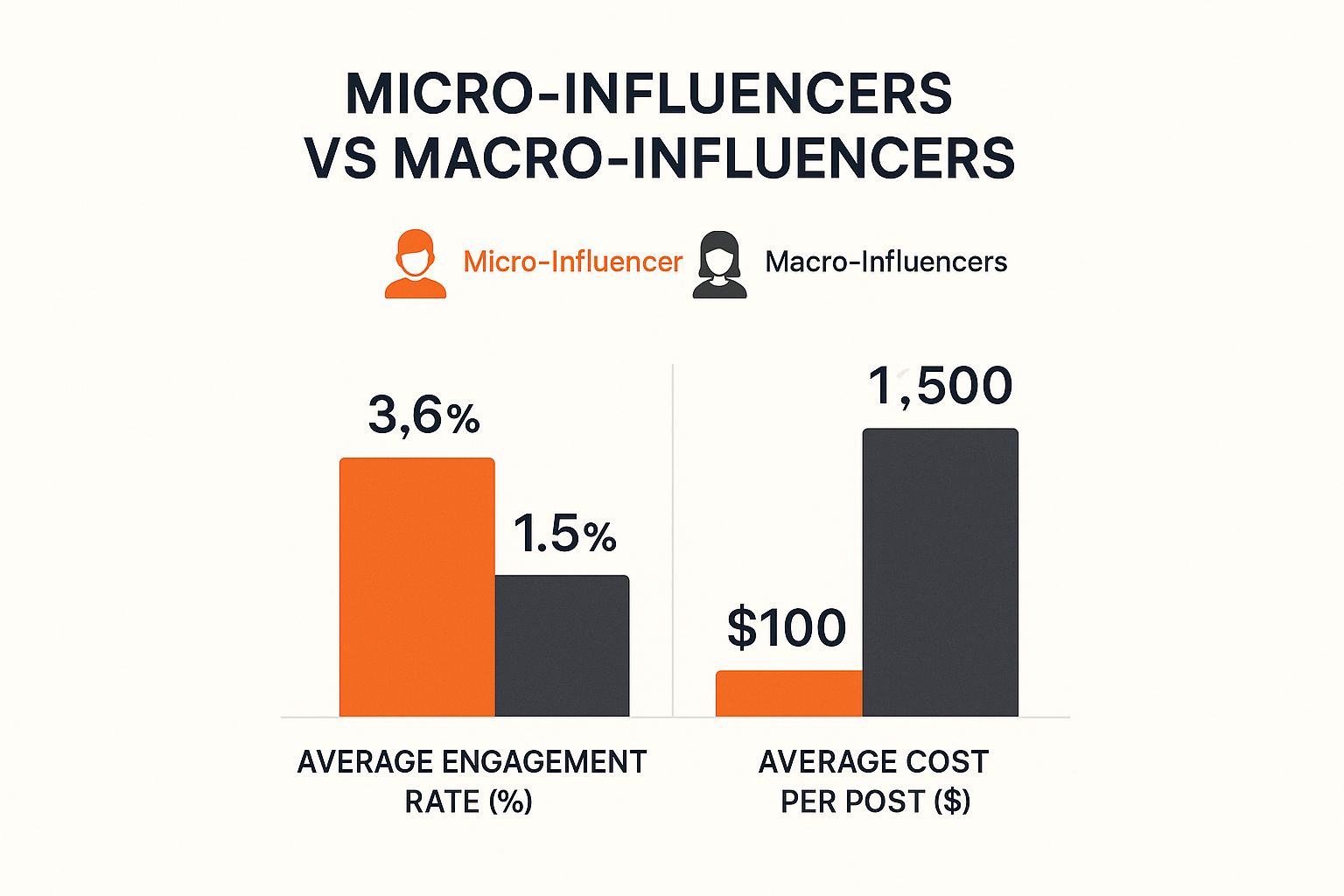
It’s pretty clear: micro-influencers tend to deliver more bang for your buck with higher engagement, while macro-influencers give you that broad-stroke visibility for a bigger investment.
To make this even clearer, let's break down how these tiers stack up against each other and where they fit best.
Comparing Influencer Tiers for Your Campaign
| Influencer Tier | Follower Range | Typical Engagement Rate | Best For |
|---|---|---|---|
| Nano | 1k – 10k | Very High (5-10%) | Hyper-local targeting, building grassroots buzz, and generating authentic user-generated content (UGC). |
| Micro | 10k – 100k | High (3-5%) | Driving conversions in niche markets, building community trust, and getting credible product reviews. |
| Macro | 100k – 1M | Moderate (1-3%) | Large-scale brand awareness campaigns, reaching broader demographics, and adding a layer of professionalism. |
| Mega | 1M+ | Low (0.5-2%) | Maximum visibility for major product launches, celebrity endorsements, and making a massive market splash. |
Each tier serves a purpose. The trick is knowing which one aligns with the specific job you need doing.
Aligning Tiers with Your Business Objectives
Right, let’s tie all this back to actual business goals. The objective of your campaign should be the single biggest factor in deciding which influencer tier to go for.
For instance, if your main goal is to drive sales for a niche product, a squad of micro-influencers is your best bet. Their genuine recommendations can spark conversions at a much higher rate than a celebrity post ever could. In fact, 74% of consumers say they trust social posts from "normal" people when deciding what to buy.
On the flip side, if you're launching a new product and need mass brand awareness, a macro- or mega-influencer can get your brand in front of millions of people almost overnight. The aim here isn't necessarily direct sales, but to make a huge noise and build instant recognition.
The most powerful influencer strategies often mix and match. You might have a mega-influencer kick things off with a big announcement, while a team of micro-influencers follows up with the authentic, detailed content that builds real trust and pushes people to act.
Choosing the Right Level of Service
Just as you match influencers to goals, you need to match the type of influencer marketing service to what your business can handle internally. Not everyone needs a full-blown, hands-off agency experience.
Here’s a quick rundown of the main options:
- Full-Service Agencies: These guys do it all, from strategy and finding influencers to managing the campaign and reporting on the results. It's the perfect choice for businesses that want expert guidance without having to dedicate their own team to the task.
- Specialised Platforms (SaaS): Think of these as toolkits. They are software platforms that help your in-house team find, manage, and analyse influencer campaigns more effectively. This is ideal if you already have the people but just need the right gear.
- Hybrid Models: Some services offer a bit of both. You get access to a platform, but you can also bolt on strategic advice or managed services when you need them. It’s a flexible approach that can grow with you.
At the end of the day, whether you need a fully managed campaign or just better tools for the job, understanding these differences ensures your budget goes exactly where it will make the biggest difference.
Building a Campaign Strategy That Delivers Results
Kicking off a partnership with an influencer marketing service doesn't start with that first email to a creator. Not even close. It begins with a solid plan. Without a clear strategy in place, even the most plugged-in agency will be fighting an uphill battle to get you meaningful results. The groundwork you lay beforehand is the blueprint for everything that follows.
Think of it like building a house. You wouldn't just hire a construction crew and say, “build me something nice.” You’d hand them a detailed set of architectural plans, mapping out everything from the foundation to the roof tiles. It's the same principle here. A clear, detailed strategy ensures your agency partner can build a campaign that’s structurally sound and perfectly aligned with what your business actually needs.
Defining Clear and Measurable Objectives
The first, and most critical, step is figuring out what success actually looks like for you. Vague goals like "increase brand awareness" just don't cut it. You need specific, measurable objectives that leave no room for interpretation. A professional agency will use these goals to shape every single part of the campaign, from which creators they pick to the style of the content.
You need to get specific about your goals, which usually fall into one of two buckets:
- Brand-Centric Goals: These are all about perception and reach. Think things like increasing your social media following by 20%, boosting website traffic from social by 30%, or landing a certain number of media mentions.
- Action-Centric Goals: These are tied directly to customer behaviour and, ultimately, revenue. This could mean hitting a target for app downloads, driving a specific number of sales using unique discount codes, or generating a set amount of qualified leads for your sales team.
Getting these Key Performance Indicators (KPIs) nailed down from day one means both you and your agency are running towards the same finish line. This clarity is what separates a campaign that feels good from one that actually grows your business.
Identifying Your Target Audience Precisely
Once you know what you want to achieve, you have to define who you want to reach. Simply saying "millennials" or "small business owners" is way too broad. The more detailed you can get with your audience persona, the better your agency will be at finding influencers whose followers are a perfect match.
Build a proper profile of your ideal customer. Go beyond demographics like age, location, and income, and dig into their psychographics. What are their hobbies and interests? Which online communities do they hang out in? What kind of content do they genuinely enjoy and trust? This level of detail is gold dust for an agency's discovery process.
A well-defined target audience is the compass for your campaign. It guides every decision, ensuring your message lands not just with a large audience, but with the right audience—the people most likely to connect with your brand and actually do something.
Creating a Strong and Collaborative Creative Brief
The final piece of the puzzle is the creative brief. This document is your main tool for communicating your vision to both the agency and the influencers themselves. It has to strike a tricky balance: providing clear brand guidelines while leaving enough space for the creator's own voice and creativity to come through. A brief that’s too restrictive will lead to content that feels stiff, robotic, and inauthentic.
Your brief should clearly lay out:
- Key Messages: What are the one or two absolute core things you want the audience to remember?
- Brand Guidelines: Lay out your "dos and don'ts," like specific phrases to use or avoid, and any visual style requirements.
- Campaign Mandatories: List the essentials. This could be a specific call-to-action, a tag to your brand's account, or a mandatory hashtag.
- Creative Freedom: Be explicit about where the influencer can be creative. Trusting their expertise is the key to getting content that actually connects with their audience.
By putting in this groundwork, you set the stage for a truly collaborative and successful partnership. You provide the strategy and the vision, which empowers your chosen influencer marketing service to execute it flawlessly and deliver the results your business needs.
The Future of Influencer Marketing and What It Means for You
The world of influencer marketing moves fast. Incredibly fast. What worked like a charm last year can feel completely out of touch tomorrow, and if you want to make your budget work hard, you’ve got to stay ahead of the game. Understanding what's coming next isn't just about being trendy; it's about making smarter choices that keep your strategy sharp and relevant.
One of the biggest game-changers is artificial intelligence. AI isn't some far-off sci-fi concept anymore; it's a very real tool that top-tier services are using right now. It can comb through millions of creators to find the perfect match for a brand, predict campaign performance with scary accuracy, and even sniff out fraudulent activity like bot farms and fake followers.
This data-first approach takes a massive amount of guesswork out of the equation. Here in the UK, this is already catching on, with over 60% of marketers planning to use AI tools in their 2025 influencer strategies to get their targeting and content right. These tools help pinpoint the ideal influencers and really nail the promotional content. You can learn more about these industry benchmarks and trends.
From One-Off Posts to Long-Term Partnerships
Another massive shift we're seeing is the move away from single, one-and-done sponsored posts. Brands are finally waking up to the fact that you can't build genuine trust overnight. The focus is now shifting towards building proper, long-term ambassador programmes and creating sustained partnerships with creators.
Think of it like this: what's more believable? A fleeting celebrity endorsement, or a genuine advocate who repeatedly shows their love for a brand? When an influencer works with you over months, or even years, their audience sees a real, consistent relationship bloom. That sustained exposure builds far more credibility than any one-time post ever could.
This way of thinking has some serious perks:
- Deeper Authenticity: The influencer's connection to the brand just feels more real to their followers.
- Consistent Messaging: Your brand's story gets told over and over, hammering home the key points.
- Greater ROI: Long-term collaborations nearly always produce better results as that trust and familiarity grow.
It's all about playing the long game. A quality influencer marketing service will help you spot creators who aren’t just a good fit for a single campaign, but who can become true, long-term partners for your brand and deliver value that lasts.
Adapting to New Platforms and Formats
Finally, the platforms themselves are in a constant state of flux. The explosion of short-form video on places like TikTok and Instagram Reels has completely changed how people consume content. A nice static image still has its place, of course, but snappy, engaging video is now king.
The best services are already adapting their strategies to put these formats first. They get the unique creative language of each platform and help brands create content that feels totally native and compelling, not like a clunky, out-of-place advertisement. Keeping up with these changes is vital to understanding the full scope of influencer marketing benefits and prime opportunities.
The future of influencer marketing isn't about chasing every fleeting trend. It's about building smarter, more authentic, and lasting connections. By embracing AI, fostering long-term partnerships, and adapting to new content formats, your brand can stay ahead of the curve in this incredibly dynamic field.
Common Questions About Influencer Marketing Services

Even with the best strategy in hand, diving into influencer marketing services can feel a bit like stepping into the unknown. It’s completely normal to have a few practical questions pop up. Getting straight answers is the best way to build the confidence you need to invest wisely and find the right team for your brand.
Think of this as your final checklist before taking the plunge. We’re tackling the most common questions we hear from businesses, with clear, no-nonsense answers to guide your next move.
How Much Does an Influencer Marketing Service Cost in the UK?
This is the big one, and the honest answer is: it depends. The cost can swing wildly based on how complex your campaign is, the types of influencers you want to work with, and the agency's own service model. There really isn't a one-size-fits-all price tag.
You’ll typically see a few different pricing structures. Some agencies work on a monthly retainer, which could be anything from £1,000 to over £10,000. Others might charge a one-off project fee or take a percentage of your total campaign spend.
To avoid any nasty surprises down the line, always insist on a detailed proposal. It should break down every single cost, from the agency’s fees to the payments going directly to the influencers. That kind of transparency is non-negotiable for understanding your total investment.
How Is the ROI of an Influencer Campaign Measured?
Return on investment always comes back to the specific goals you set at the very beginning. A good influencer marketing service will sit down with you to define what success actually looks like and then put the right tracking in place to measure it properly.
- For awareness goals, they’ll be tracking metrics like reach, impressions, and engagement rates.
- For sales goals, they get more granular. Think unique discount codes, custom affiliate links, and UTM parameters that directly link sales and revenue back to specific influencers.
The key takeaway here is that modern influencer marketing is all about the data. A professional service won't just throw vanity metrics at you. They’ll deliver a clear analysis showing exactly how the campaign impacted your bottom line.
Are Influencer Marketing Services a Good Fit for Small Businesses?
Absolutely. In fact, many agencies and services are set up specifically to work with small to medium-sized businesses. They often specialise in crafting incredibly effective campaigns using micro- and nano-influencers, which can be far more cost-effective.
These smaller-scale campaigns can generate immense engagement within niche communities, giving smaller brands a direct and authentic line to their ideal customers. For a small business, using a service provider removes the huge time-suck of manual outreach and management, making influencer marketing a powerful and accessible way to grow.
Ready to see how a professional influencer marketing service can transform your brand's reach and results? The team at Colossal Influence has over a decade of experience connecting brands with authentic creators to deliver campaigns that truly connect. Explore our services and start building your strategy today at https://www.colossalinfluence.com.
Follow us on Social Media


