

Use of an influencer marketing agency is no longer something a few companies do, it’s practically a requirement. It is a budget line that boards, brand teams, and PR leads now have to justify properly. Market spend in the UK rose from £485 million in 2019 to an estimated £1.5 billion by 2025, with roughly 25% CAGR, according to Statista’s influencer market size data.
That changes the role of an influencer marketing agency. A good agency is not just a broker between brands and creators. In the UK, it has to operate like a specialist function inside the wider marketing team. It needs to know how to source talent, structure briefs, protect the brand on ASA and CMA rules, and prove commercial value beyond likes.
For beauty, sports, travel, and lifestyle brands in particular, the gap between average execution and disciplined execution is wide. The campaigns that work usually have tighter creator selection, clearer compliance processes, and stronger tracking from day one. The campaigns that disappoint tend to overpay for reach, chase the wrong creators, or report activity without proving business impact.
The Unstoppable Rise of Influencer Marketing in the UK
The growth in UK influencer marketing has been sharp enough to change how brands organise spend and decision-making. What used to sit in social as an experiment now touches media planning, legal review, ecommerce, PR, and performance reporting.

An agency now fills the gap between brand ambition and operational reality. That matters in the UK because the market is crowded, creator quality varies, and compliance is not optional. A brand can certainly run creator campaigns in-house, but once activity scales across multiple creators, product lines, or retail moments, complexity rises fast.
Why the agency model matters more now
The modern UK brand rarely needs another list of creators. It needs:
- Audience fit: creators whose followers match the right customer profile, not just broad reach.
- Platform judgment: knowing when TikTok, Instagram, YouTube, or LinkedIn serves the brief.
- Commercial discipline: tracking links, conversion paths, and post-campaign analysis.
- Risk control: disclosure standards, contract terms, gifting rules, and approvals.
This is why agencies have become more strategic. They are increasingly responsible for filtering poor-fit creators, protecting the brand from sloppy execution, and turning creator content into a measurable marketing asset.
Key takeaway: In the UK market, the agency’s value is less about access alone and more about judgment, governance, and measurement.
The strongest agency relationships tend to look less like one-off outsourcing and more like an embedded specialist team that can move between brand, legal, ecommerce, PR, and paid social without losing control of the campaign.
Understanding the Modern Agency’s Core Functions
A serious influencer marketing agency works like an outsourced specialist department. It should plug into the client’s wider marketing operation, not sit on the edge of it.
In the UK, that matters because influencer activity now carries enough spend and enough scrutiny to require proper systems. According to eMarketer’s 2025 influencer marketing agencies coverage, 74% of marketing agencies and brands in the UK dedicate over 25% of their digital budgets to influencer marketing as of 2025.
Strategy before creator outreach
The first job is not contacting creators. It is defining the commercial brief.
That means clarifying whether the brand needs awareness, consideration, direct sales, retail support, launch momentum, or content production. A good agency will also challenge weak briefs. “We want creators on TikTok” is not a strategy. It is a channel preference.
Talent sourcing and fit
Creator selection is where many campaigns win or fail. A capable agency reviews audience relevance, content quality, disclosure habits, platform strengths, and likely brand fit.
This is also where process matters. The workflow usually depends on proper shortlist management, content approvals, timelines, and reporting dashboards. For teams refining operations across channels, practical stacks such as social media management tools for agencies can help organise approvals, publishing visibility, and collaboration around campaign delivery.
Campaign delivery
Execution is the part clients see, but it rests on a lot of background work.
Typical agency responsibilities include:
- Briefing creators: shaping deliverables, messaging boundaries, and usage rights.
- Managing approvals: keeping content aligned without stripping out the creator’s voice.
- Handling logistics: timelines, contracts, gifting, launches, and product dispatch.
- Coordinating stakeholders: brand managers, PR leads, ecommerce teams, and legal reviewers.
Some brands use a partner for end-to-end delivery through specialist influencer marketing services, especially when internal teams need external support for creator sourcing, campaign management, and reporting.
Reporting and optimisation
The best agencies do not stop at posting. They look at what moved.
A report should explain which creators produced traction, which content themes performed, where audience quality was strong or weak, and what should change next time. If reporting only lists impressions, likes, and a few screenshots, the agency is acting as a coordinator, not a strategic partner.
Practical rule: If an agency cannot explain how it chooses creators, handles approvals, and reports outcomes, it is not operating at the level most UK brands need in 2026.
B2C vs B2B Influencer Marketing A Strategic Comparison
B2C and B2B influencer work share a label, but they are not the same discipline. The brief, creator profile, content format, and buying journey all change.
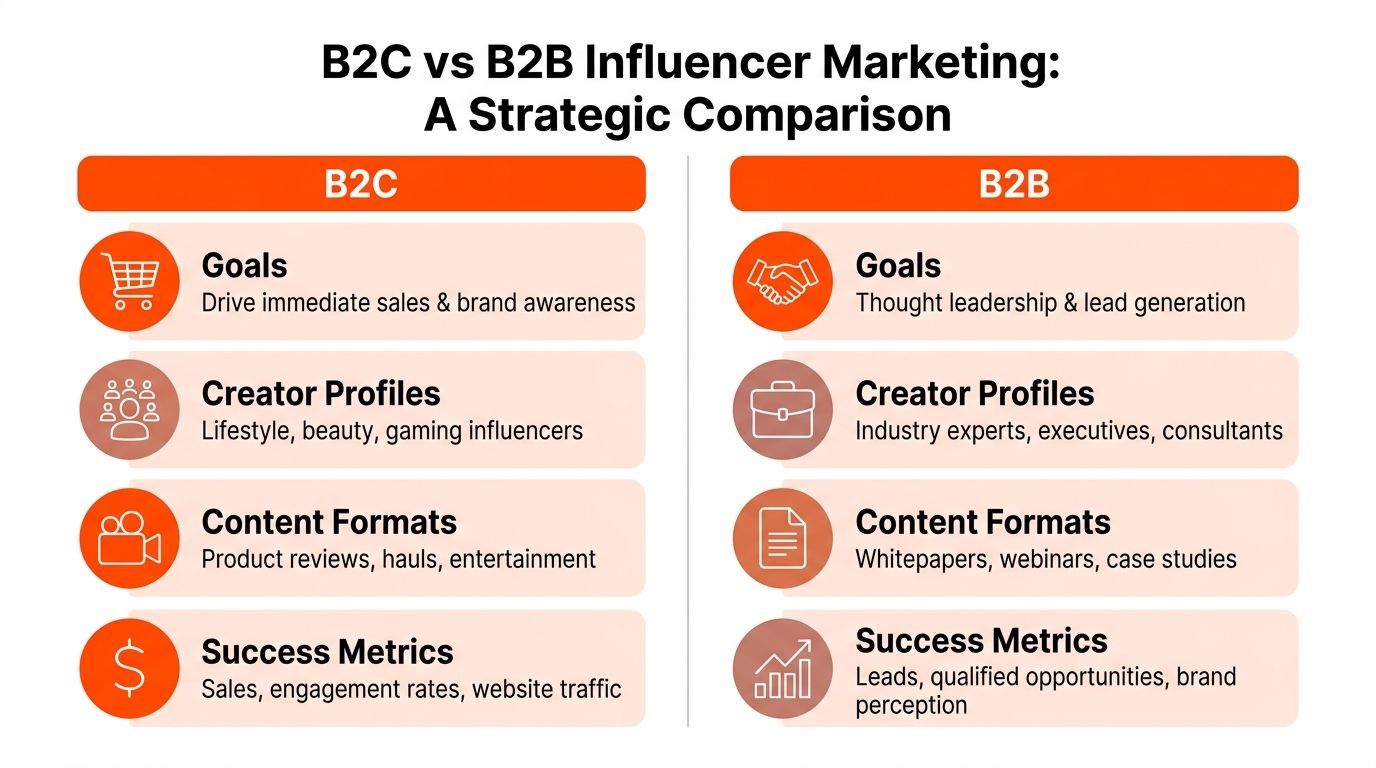
A consumer beauty launch and a B2B software campaign should not be built on the same assumptions. One often aims to create immediate product desire and social proof. The other usually needs authority, education, and trust across a longer sales cycle.
B2C vs. B2B Influencer Marketing at a Glance
| Criterion | B2C (Business-to-Consumer) | B2B (Business-to-Business) |
|---|---|---|
| Audience | Individual shoppers and end users | Buyers, teams, decision-makers, and specialists |
| Primary objective | Brand awareness, product demand, direct sales | Thought leadership, trust, lead generation |
| Creator type | Lifestyle, beauty, gaming, fitness, travel creators | Industry experts, consultants, founders, executives |
| Content style | Reviews, hauls, demos, short-form video, creator-led storytelling | Webinars, interviews, expert commentary, educational content |
| Buying cycle | Often shorter and more impulse-led | Usually longer and more considered |
| Tone | Aspirational, relatable, entertaining | Credible, informed, problem-solving |
| Success markers | Engagement, traffic, product sales, content performance | Lead quality, meeting generation, authority, sales support |
Where agencies need to adapt
In B2C, creator fit usually hinges on audience relevance and the ability to make a product feel part of daily life. A beauty brand may need visible product use, clear routines, and creator credibility in a niche. A sports brand may need performance context and trust from an active audience.
In B2B, follower count often matters less than professional authority. A niche consultant with a respected LinkedIn audience can outperform a general business creator with broader reach. The content also needs more substance. Decision-makers usually want informed perspective, not just endorsement.
Common briefing mistakes
The wrong brief can cripple both models.
- B2C mistake: writing scripts so tightly that the content stops sounding native to the creator.
- B2B mistake: choosing creators for visibility alone when the underlying need is trust and category expertise.
- Shared mistake: asking for “awareness” without defining what commercial outcome should follow.
Tip: Brands should brief the agency around the buying journey first, then choose creators and platforms. Starting with platform popularity usually leads to shallow planning.
Developing a Winning Campaign Strategy with Your Agency
Good influencer strategy is usually less glamorous than marketers expect. It is built on fit, repetition, and disciplined testing. That is why smaller creators and longer partnerships often beat louder one-off activations.

According to Sprout Social’s influencer marketing metrics guidance, top-quartile influencer campaigns in the UK exceed an Influence Engagement Rate of 4.2% on TikTok and Instagram, and micro-influencers often yield 2.3x higher ROI, or £4.50 return per £1 spent.
Why micro-influencers often outperform
Micro-influencers tend to work when a brand needs trust, relevance, and audience response rather than broad vanity reach. That is especially useful in UK beauty and sports, where people pay close attention to authenticity, product use, and creator consistency.
A large creator can still be right for a launch. But if the brand needs stronger purchase intent or more credible product integration, the smaller and better-matched creator often does more commercial work.
Long-term programmes beat one-off bursts
One sponsored post can create visibility. It rarely builds memory on its own.
Ambassador structures usually create better conditions for performance because they give the audience repeated exposure to the product in a believable context. The creator also gets time to understand the product properly, which improves the quality of the content and reduces forced messaging.
This is one reason many brands move from ad hoc gifting into a more structured influencer campaign model with recurring creator activity, review cycles, and clear performance benchmarks.
Strategic choices that usually work
- Use creators by role, not just size: one creator may be best for awareness, another for conversion, another for polished content production.
- Match platform to buying behaviour: TikTok can create discovery quickly, while Instagram often supports stronger product consideration and repeat exposure.
- Build content clusters: a launch works better when creators publish around a shared moment with enough variation in angle and audience.
- Plan for paid usage early: if the brand may repurpose creator content, rights and approvals need to be agreed before content goes live.
What tends not to work
Shortlists built around follower count alone are a common problem. So are briefs packed with brand language that creators would never use naturally.
Another weak pattern is treating all creators the same. A sports performance creator, a beauty educator, and a travel storyteller need different formats, proof points, and pacing. A campaign strategy should reflect that, otherwise the content becomes generic and loses force.
Practical takeaway: The strongest agency strategies usually prioritise audience trust, creator fit, and repeated exposure over the biggest possible reach number.
Navigating UK Compliance and Advertising Regulations
Many brands still treat compliance as a final review step. In the UK, that is a mistake. It needs to be part of planning, briefing, contracting, and content approval from the start.
The stakes are no longer theoretical. The UK Competition and Markets Authority has taken numerous enforcement actions against influencers in 2024 and 2025 for non-disclosure, and compliant UK campaigns often achieve higher engagement.
The hands-off model creates avoidable risk
Some brands still assume the creator should “know the rules” and handle disclosure alone. That is not a serious operating model. If a post is unclear, the brand still absorbs reputational damage, internal disruption, and potential regulatory fallout.
A competent agency should check disclosure language, review content before posting where appropriate, and maintain a clear audit trail. This becomes even more important when campaigns involve gifting, affiliate structures, product seeding, or layered compensation.
What compliance looks like in practice
In UK campaigns, good compliance usually includes:
- Clear disclosure: the commercial nature of the content should be obvious.
- Written instructions: creators need documented guidance, not casual verbal reminders.
- Approval control: where risk is higher, content should be reviewed before publication.
- Record keeping: contracts, briefing notes, and approval histories should be easy to retrieve.
Brands that need a clearer view of product seeding and legal considerations can review specialist guidance on influencer gifting laws.
Compliance also protects performance
There is a persistent fear that disclosure harms results. In practice, unclear or clumsy disclosure is more damaging because it weakens trust. When the audience feels misled, the content tends to perform badly anyway.
The better approach is straightforward. Choose creators who already know how to integrate paid partnerships naturally, brief them clearly, and make disclosure part of normal campaign craft rather than a legal afterthought.
Tip: If a creator regularly resists transparent disclosure, that is usually a talent selection issue, not a formatting issue.
Measuring What Matters True Campaign ROI and KPIs
Most weak influencer reporting suffers from the same problem. It describes activity rather than proving value.
Likes, comments, shares, reach, saves, and views all have their place. But commercial teams need to know what happened after the audience engaged. Did people click, browse, buy, sign up, or return later through another channel? That is where proper measurement starts.

According to Stellar’s guide to influencer marketing KPIs, agencies use UTM tracking to attribute traffic and conversions. In UK campaigns, Instagram engagement rates above 3.5% correlate with 25% to 40% higher conversion rates, and this approach can reduce CPA to £15 to £25 for mid-tier brands.
The KPI stack that matters
A proper reporting framework usually starts with four layers.
| KPI layer | What it shows | Why it matters |
|---|---|---|
| Visibility | Reach, impressions, views | Confirms delivery and distribution |
| Engagement quality | Saves, shares, comments, engagement rate | Shows whether the content resonated |
| Traffic behaviour | Clicks, sessions, landing page behaviour | Connects creator content to site activity |
| Commercial outcome | CPA, conversions, revenue contribution | Ties spend to business results |
Why UTMs are essential
UTMs are one of the simplest ways to separate creator traffic cleanly inside analytics platforms. Without them, reporting often turns into guesswork. A brand sees sales movement, but cannot tell which creator drove what, or whether a strong-looking post ultimately converted.
That matters even more in sectors such as beauty and sports, where multiple creators may be active around the same launch window. Clean tracking makes it possible to compare creators fairly, spot drop-off points, and decide who deserves repeat investment.
Vanity metrics vs decision metrics
A creator can post content that looks strong in-platform and still deliver poor business results. Another creator can generate quieter social numbers and send highly qualified traffic that converts better.
That is why reporting should include:
- Creator-level traffic data
- Landing page conversion data
- Cost per acquisition
- Content type comparison
- Audience quality observations
For teams tightening the post-click experience after creator traffic lands, this guide on how to improve e-commerce conversion rate and boost sales is a useful companion read. The landing page often decides whether good creator traffic becomes revenue.
Questions brands should ask in every report
- Which creators drove qualified traffic, not just engagement?
- What content formats produced the best conversion behaviour?
- Where did users drop off after the click?
- Which creators should move into long-term activity?
Key takeaway: If an influencer marketing agency cannot track creator-specific traffic and explain post-click performance, it is only measuring attention, not ROI.
Choosing the Right Agency Partner for Your Brand
Agency selection should be practical. The right partner is the one that fits the brand’s category, internal workflow, risk tolerance, and reporting needs.
A shortlist should focus on evidence of operating discipline, not polished sales language alone. For brands comparing options, a useful benchmark is this overview of what defines the best influencer marketing agency.
A solid evaluation checklist includes:
- Sector fluency: can the agency talk credibly about beauty, sports, travel, or the brand’s niche?
- Compliance process: how does it handle ASA and CMA disclosure checks?
- Creator selection logic: what criteria decide who makes the shortlist?
- Reporting depth: can it show traffic, conversion, and CPA data rather than platform screenshots?
- Workflow fit: will it integrate with ecommerce, PR, legal, and paid media teams?
The best partnerships usually feel calm, organised, and commercially grounded. That is a better signal than big promises.
Frequently Asked Questions About Influencer Agencies
What does an influencer marketing agency typically do day to day?
It sources creators, negotiates terms, builds briefs, manages approvals, oversees delivery, tracks performance, and keeps the campaign compliant. In stronger setups, it also advises on platform choice, content rights, and post-campaign optimisation.
Should a brand use an agency or a self-service platform?
A platform can help with discovery and outreach. An agency is more useful when the brand needs strategy, compliance oversight, structured reporting, and campaign management across multiple moving parts. The more risk and complexity involved, the more valuable hands-on agency support becomes.
How long does it take to launch a first campaign?
That depends on approvals, creator availability, product logistics, and content sign-off. Campaigns move faster when the brief is clear, legal review is organised early, and tracking links are prepared before outreach begins.
What should a brand ask before signing?
Ask how creators are selected, how disclosures are managed, what reporting looks like, how paid usage is handled, and who owns day-to-day delivery. If the answers stay vague, expect vague results.
Are micro-influencers always better?
No. They are often stronger for trust, niche relevance, and conversion-led work, but not every objective calls for them. Product launches, retail moments, and broad awareness pushes may require a mixed creator tier strategy.
Brands that want influencer activity to work in 2026 need more than creator access. They need strategy, compliance control, and reporting that connects content to commercial results. Colossal Influence works with brands, agencies, and creators across sectors including beauty, sports, and travel, with support spanning talent management, campaign delivery, and consultancy.
Follow us on Social Media


