

A social media influencer marketing agency helps brands plan, source and manage creator campaigns across platforms such as YouTube, Instagram and TikTok. The work goes well beyond finding creators: it includes audience fit, outreach, negotiation, contracts, briefing, approvals, usage rights, compliance, campaign delivery and reporting.
Colossal Influence has worked in creator-brand partnerships since 2012 and has operated as a dedicated agency since 2014. Our campaign history includes multi-creator work for Chelsea FC, an Instagram campaign for Amazon Prime Video, a long-running LELO relationship spanning 30 creator campaigns, and repeat creator partnerships with brands including FlexiSpot and Beducated.
For brands, the value of a specialist social media influencer agency is operational as much as creative. The right partner should know which creators fit the brief, how to negotiate the commercial terms, how much control the brand genuinely needs, and how to keep several creators moving through approvals and publishing without losing the authenticity that made them useful in the first place.
This guide explains what brands should expect from a social media influencer marketing agency, how the service differs from informal creator outreach, and how to judge whether an agency has the systems and experience to manage campaigns properly.
The Modern Influencer Marketing Challenge
A lot of internal teams start in the same place. Someone spots a creator who fits the brand, sends a direct message, agrees a fee, gets a post live, and hopes sales or awareness move in the right direction. That can work once. It rarely scales cleanly.
The problem isn't effort. It's coordination. Influencer marketing now sits at the intersection of brand, legal, content, paid social, partnerships, analytics, and customer insight. If one part breaks, the campaign underperforms. If two parts break, the brand often can't tell why.
Where brands get stuck
Most stalled programmes run into a familiar set of issues:
- Creator selection becomes reactive: Teams choose people they recognise rather than people whose audiences fit the brief.
- Briefs swing too loose or too rigid: Loose briefs produce off-brand content. Overcontrolled briefs produce flat content that audiences ignore.
- Measurement lacks discipline: Teams can see likes and comments, but they can't connect creator output to traffic, conversion quality, or share of voice.
- Compliance gets treated as admin: Disclosure, approval flows, usage rights, and data handling are left until the end.
That last point is where many guides fall short. In the UK, compliance isn't a footnote. It's part of campaign design.
A strong influencer campaign should be built like a launch plan, not handled like a casual collaboration.
A capable agency acts as the operating layer between the brand and the creator economy. It doesn't replace the brand's strategy. It gives that strategy a delivery system.
Brands that are still defining the basics should first get clear on what influencer marketing is. After that, the key question isn't whether creators can help. It's whether the business has the structure to run creator partnerships repeatedly, safely, and profitably.
What an Influencer Agency Actually Does
An influencer agency is often described as a matchmaker. That description is too small. A better analogy is an architect and orchestra conductor in one.
The brand brings the commercial goal. The agency turns that goal into a workable campaign design, assembles the right people, keeps everyone in sync, and corrects course when the live performance starts drifting.
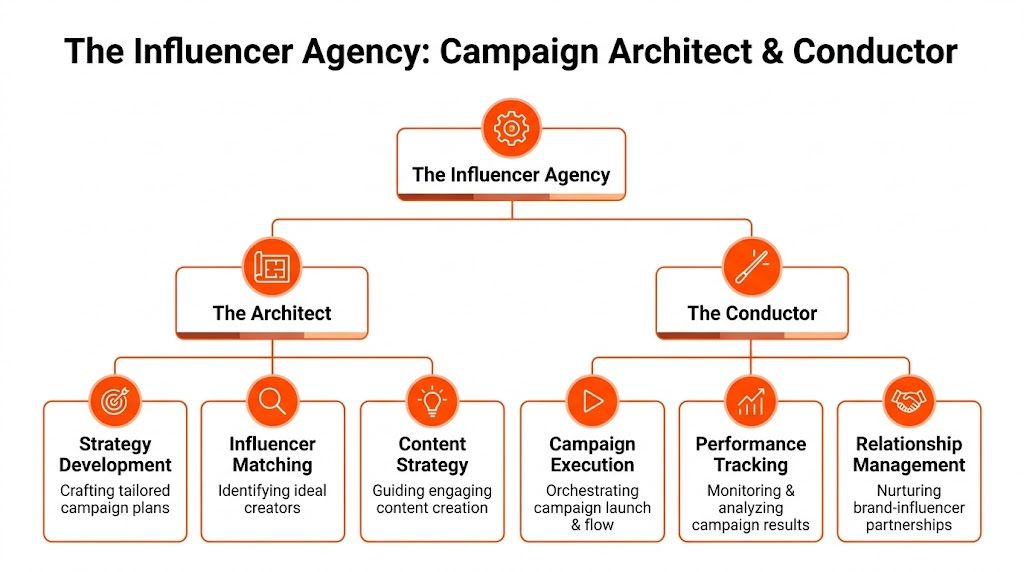
The architect role
Before any creator is contacted, the agency should define the shape of the campaign.
That includes audience fit, platform choice, timing, message hierarchy, content format, usage rights, and approval rules. If those pieces aren't set early, the campaign starts making expensive decisions by accident.
A serious agency also vets creators beyond surface-level popularity. It looks at content style, audience relevance, past brand behaviour, and whether the creator can deliver the kind of response the campaign needs. Reach alone is a poor filter.
The conductor role
Once creators are contracted, the work becomes operational. Timelines need managing. Drafts need reviewing. Feedback needs translating so the brand protects core messaging without sanding off the creator's voice.
Many in-house teams underestimate the workload. One campaign can involve briefing calls, revisions, legal wording, disclosure checks, posting windows, live monitoring, and performance reporting across multiple creators and platforms.
For teams exploring the wider shift toward structured creator operations, this overview of understanding the role of agents in influencer marketing is useful context.
The agency's value is often invisible when things go well. Posts go live on time, contracts are clean, disclosures are clear, and reporting makes sense. That's the point.
The functions brands should expect
A competent social media influencer agency usually covers several core responsibilities:
- Strategy development: Translating business goals into campaign mechanics.
- Talent sourcing and vetting: Identifying creators whose audiences and content behaviours align with the brief.
- Negotiation and contracts: Handling fees, deliverables, usage rights, exclusivity, and payment terms.
- Creative management: Building briefs, coordinating revisions, and protecting both brand standards and creator authenticity.
- Live campaign oversight: Tracking delivery, troubleshooting issues, and adjusting where needed.
- Reporting and interpretation: Turning campaign output into decisions for the next activation.
Brands that want a clearer view of the commercial structure behind agency work can review how influencer agencies make money. Understanding that model helps when assessing whether a partner is incentivised to build durable programmes or push volume.
Core Agency Services That Drive Campaign Success
Campaign success is decided long before the first post goes live. The service layer is where agencies protect budget, shape performance, and stop compliance mistakes from becoming public problems.

Strategy and creator vetting
Good agencies filter for commercial fit, not just aesthetic fit. A creator can look perfect on the grid and still be wrong for the brief if their audience does not trust recommendations, if their content style cannot demonstrate the product properly, or if their past brand work creates confusion.
That assessment needs more than a follower count and a few screenshots. Agencies use platform data, comment quality checks, audience location review, brand safety screening, and performance history to decide who should make the shortlist. Sprout Social’s influencer marketing metrics guide is a useful reference for the measurement side, especially when teams need a sharper view of share of voice and campaign effectiveness.
In practice, this works like casting for a TV advert. Reach matters, but fit, delivery, and audience response decide whether the spend pays back.
Contracts, rights, and compliance control
This is the part many brands underestimate. A UK-based agency is not only buying access to creators. It is handling legal and regulatory exposure that can damage a campaign after strong creative work has already been delivered.
Contracts need to cover usage rights, timing, exclusivity, edit control, cancellation terms, payment milestones, and disclosure requirements. In the UK, they also need to reflect ASA and CMA expectations around ad labelling, misleading claims, and the commercial relationship between brand and creator. That is where experienced agencies earn their fee. They check briefs, captions, approval flows, and post language with compliance in mind, rather than treating regulation as a last-minute legal review.
A weak workflow creates two expensive outcomes. Content misses the moment, or risky content goes live.
Practical rule: Lock the brand requirements early. Leave room for the creator’s delivery style, but never leave disclosure wording or claims to chance.
Brands weighing the value of that oversight can review why brands work with an influencer agency for a clearer picture of what sits behind campaign delivery.
Reporting, diagnostics, and in-flight decisions
Strong agencies do not wait for a final report to spot problems. They monitor live performance closely enough to change course before weak content absorbs more budget.
That includes checking which formats are driving response, whether traffic quality matches the original audience plan, whether sentiment is slipping, and whether certain creators should receive more paid support or less. Some teams support this process with specialist software across discovery, approvals, and reporting. For marketers comparing platforms, this roundup of best influencer marketing tools is a practical reference point.
One example in the UK market is Colossal Influence, which provides both talent management and consultancy services.
What to expect from the service layer
A serious agency should be able to show clear working methods in areas like these:
- Audience analysis: Who follows the creator, why they engage, and whether that audience matches the brief.
- Format planning: Matching creators to Reels, TikTok, Stories, duets, or static content based on likely performance.
- Content governance: Briefing, feedback rounds, disclosure review, and posting approvals.
- Commercial administration: Fee handling, contract terms, invoicing, and creator payments.
- Performance interpretation: What happened, why it happened, and what should change in the next campaign.
If an agency cannot explain those mechanics plainly, it is probably acting as a broker rather than managing outcomes.
The Tangible Benefits of Agency Partnership
The strongest case for an agency isn't convenience. It's compound advantage. A disciplined partner improves creator selection, reduces wasted spend, protects the brand from avoidable mistakes, and makes the programme easier to repeat.

Better commercial efficiency
A well-run creator campaign doesn't always come from the biggest names. In UK influencer marketing, ON Social’s analysis of how agencies use data in campaigns reports that nano-influencers with 1k to 10k followers achieve 2.5x higher engagement rates, averaging 4.8%, compared with macro-influencers at 1.1%. The same source states that this directly caused a 35% uplift in conversion rates for beauty and lifestyle campaigns, producing £4.50 earned media value per £1 spent for optimised UK partnerships.
That’s a useful reminder that efficiency often beats scale. Brands frequently overspend when they buy audience size instead of audience response.
Lower risk and cleaner execution
Agencies also save money in quieter ways. They catch disclosure problems before posts go live. They tighten approval windows. They prevent duplicated outreach, unclear rights, and weak creator fit.
Those gains rarely appear in a flashy slide, but they matter. Every campaign has friction points. A capable agency removes many of them before they become costs.
Access and continuity
The other benefit is continuity. Internal teams change priorities quickly. Agencies maintain creator relationships, campaign memory, and process discipline across launches.
That continuity affects quality in several ways:
- Stronger creator matching: Agencies know which creators can sell, educate, entertain, or launch.
- Faster campaign assembly: Existing relationships shorten outreach and negotiation cycles.
- Improved repeatability: Lessons from one campaign inform the next instead of disappearing in a shared inbox.
- Clearer internal reporting: Marketing leaders get a more coherent view of spend, output, and outcome.
Brands usually see the biggest improvement when they stop treating influencer activity as a series of isolated posts and start managing it as a portfolio.
For teams weighing whether that shift is worth making, why brands work with an influencer agency is the practical question to answer. The agency fee only looks expensive when the hidden costs of weak execution stay invisible.
How to Choose the Right Influencer Agency
The right agency does more than find creators. It protects the brand when campaign pressure, creator behaviour, and UK advertising rules collide.

Start with compliance, not creator lists
A large roster can look impressive in a pitch. It tells you very little about whether the agency can keep a campaign on the right side of ASA and CMA expectations.
The first test is simple. Ask the agency to explain its compliance process in plain English, without hiding behind jargon or legal theatre. A capable UK agency should be able to walk through disclosure rules, briefing language, approvals, contracts, record-keeping, and escalation steps if a creator posts something that creates risk.
That matters because compliance is not an admin task bolted on at the end. It should shape the campaign from the brief onward, including the wording creators use, the claims they can make, the way gifts or payment are disclosed, and who has sign-off authority before anything goes live.
If an agency treats regulation like a box-ticking exercise, the brand is carrying more risk than it thinks.
Questions worth asking in a pitch
Good agency selection looks closer to operational due diligence than a chemistry meeting. Strong teams answer specific questions directly. Weak teams stay broad and reassuring.
Ask questions such as:
- How do they review content for ASA and CMA compliance?
- Who signs off disclosures before posting?
- How do they handle creators who resist clear ad labelling?
- What happens if a creator posts incorrect wording or goes off-brief?
- How are usage rights and repurposing permissions written into contracts?
One answer matters more than the wording itself. The agency should have a repeatable process. If the response depends on "we usually sort it out with the creator", that is not a process. That is hope dressed up as flexibility.
Compliance check: If an agency leaves ASA and CMA review until final sign-off, it is already too late. The campaign should be built with those rules in mind from day one.
Evaluate the agency on four dimensions
Compliance comes first. The final decision usually rests on four practical areas that affect delivery quality.
| Dimension | What to look for |
|---|---|
| Strategic capability | Can the agency connect creator selection to a business objective instead of just filling a list? |
| Operational control | Does it have a clear briefing, contracting, approval, and reporting process? |
| Talent fit | Are its creators relevant to the brand’s category, tone, and audience? |
| Reporting clarity | Can it explain what success looked like, why results happened, and what should change next time? |
The trade-offs here are real. The best-performing creator may not be the most polished on camera. The safest approval process may slow turnaround. A niche creator with high trust can outperform a bigger name with weaker audience alignment. Experienced agencies say that out loud instead of overselling reach.
Experience in the UK market earns its worth. Anyone can assemble a creator list. Fewer teams can judge where creative freedom should end, where a regulated claim needs tighter controls, or when stakeholder preferences are pushing the campaign in the wrong direction.
Experience still matters
Influencer marketing still depends heavily on judgement. Platform norms shift, creators change direction quickly, and legal risk rarely appears in a neat spreadsheet before it becomes a problem.
That is even more true for UK campaigns involving finance, health, alcohol, children, or any setup with several internal approvers. In those cases, the agency is not just buying attention. It is acting as a control layer between the brand, the creator, and the regulator.
Brands that want a practical benchmark can compare an agency's offer against a structured influencer marketing service. The test is straightforward. Do its systems still hold up when a creator misses the brief, a legal query appears late, or the content needs to be reworked hours before launch?
Agency vs In-House vs DIY Influencer Marketing
Not every brand needs an agency immediately. The right model depends on budget, internal capability, campaign frequency, and risk tolerance. The mistake is choosing a model that doesn't match the operational burden.
Comparing Influencer Marketing Approaches
| Criteria | Influencer Agency | In-House Team | DIY (Founder/Marketer) |
|---|---|---|---|
| Cost | Higher direct spend, but often more structured buying and less wasted effort | Moderate to high once hiring, tools, and training are included | Lowest cash outlay at the start |
| Time commitment | Lower for the brand day to day | High internal coordination required | Very high |
| Access to expertise | Broad across strategy, contracts, creators, reporting, and compliance | Depends on who is hired and how experienced they are | Usually limited and learned on the fly |
| Scalability | Strongest option for multi-creator or ongoing campaigns | Can work with enough process and headcount | Limited |
| Risk level | Lower if the agency has strong compliance and workflow discipline | Moderate, depends on internal legal and marketing alignment | Highest |
Which model fits which stage
DIY suits early-stage brands that have more time than budget. It can work for product seeding, one-off creator tests, and founder-led outreach. The trade-off is inconsistency. The founder or marketer becomes strategist, negotiator, legal reviewer, project manager, and analyst all at once.
In-house makes sense when influencer activity is frequent enough to justify dedicated ownership and the business can support process, tools, and compliance oversight internally. This model can be strong, but only if the team's specialization is well-developed. Adding creator outreach to a social manager's workload usually creates bottlenecks.
Agency is the right fit when campaigns need to scale, reporting must be credible, and compliance risk can't be handled informally. It's also the cleanest option for PR agencies and brand teams that need execution depth without building a full internal creator operation.
The most practical test is simple. If influencer activity already feels harder to coordinate than it should, the current model has probably been outgrown.
Is an Agency Your Next Strategic Move
The decision to hire a social media influencer agency isn't really about outsourcing. It's about whether the brand wants creator marketing to remain a side activity or become a reliable growth channel.
A mature programme needs more than enthusiastic outreach and a good eye for creators. It needs structure. It needs contracts that protect usage. It needs approval systems that don't choke good content. It needs reporting that tells decision-makers what happened and what to do next. In the UK, it also needs disciplined handling of ASA and CMA expectations before a single post goes live.
That's why experienced agencies have become more valuable, not less. As influencer marketing gets more measurable and more regulated, the gap widens between campaigns that look busy and campaigns that are well run.
The strongest brands don't ask whether they can contact creators directly. Of course they can. The better question is whether direct outreach gives them the control, protection, and repeatability the business now needs.
An agency becomes the right move when creator activity stops being experimental and starts affecting brand reputation, budget efficiency, and commercial performance.
Colossal Influence works with brands, PR agencies, and creators on influencer strategy, talent management, and campaign delivery in the UK market. Teams that want a structured partner for creator selection, campaign operations, and compliance-aware execution can explore Colossal Influence.
Follow us on Social Media


