

Choosing an influencer agency in the UK should start with fit, not sales language. The right partner should understand your audience, explain how creators are selected, be transparent about commercial terms, and show a clear process for strategy, negotiation, delivery and reporting. Colossal Influence also operates as a UK influencer talent agency, so we see the decision from both the brand side and the creator side rather than treating talent as inventory.
What to look for when choosing an influencer agency
Let's be direct: trying to manage influencer campaigns all on your own is getting harder by the day. The old-school approach of just sending out free products for a quick Instagram post is long dead. To get it right in 2026, you need deep industry knowledge, solid data, and a real understanding of the ever-shifting platform algorithms and advertising regulations.

This growing complexity is exactly why so many brands are now turning to specialist influencer agencies. It’s not about just handing off a task; it's a strategic move to partner with experts who live and breathe this stuff.
The Strategic Edge of an Agency Partnership
Let’s talk about a familiar scenario. Imagine you're launching a new skincare line. Your in-house team spends weeks finding potential beauty influencers. Half of them don't reply, and the ones who do are quoting fees that make your eyes water. Sound familiar? This is a common headache, but it’s precisely what an agency is built to solve.
Partnering with an influencer agency is an investment in a strategic ally that secures better deals, provides deeper analytics, and drives measurable business outcomes. It’s about moving beyond simple outreach to achieve genuine brand growth.
A good agency walks in the door with a curated roster of creators they already have relationships with. They know the market rates inside and out, they’re masters of negotiation, and they know how to draft contracts that actually protect your brand. That access and expertise immediately put you on a much stronger footing. If you want to dig deeper into the specific benefits, you can explore more on why to work with an influencer agency: https://www.colossalinfluence.com/why-work-with-an-influencer-agency/.
The numbers don't lie. In the UK, spending on influencer marketing shot up to £1.5 billion in 2024, which was a 25% jump from the previous year. Even more telling, a 2024 study found that influencers represented by an agency landed 2.5 times more brand deals than those going it alone. Some of those campaigns delivered a massive 5.2x return on ad spend.
To give you a better idea, here's a direct comparison of handling things yourself versus bringing in the pros.
Agency Partnership vs In-House Management
| Factor | In-House Management | Agency Partnership |
|---|---|---|
| Creator Access | Limited to public searches and cold outreach. | Access to a vetted, private roster of creators. |
| Negotiation | Often overpays due to lack of rate knowledge. | Expert negotiation based on real-time market data. |
| Contracts | Uses basic templates that may leave brand exposed. | Custom, legally sound contracts protecting all parties. |
| Compliance | High risk of non-compliance with ASA rules. | Ensures all content is fully compliant with regulations. |
| Analytics & ROI | Relies on basic, often misleading, platform metrics. | Uses advanced tools to track true ROI and business impact. |
| Time Investment | A significant drain on internal marketing resources. | Frees up your team to focus on core business strategy. |
As you can see, the agency model is built for efficiency and results, letting you focus on the bigger picture while the experts handle the complex details of the campaign.
From Vanity Metrics to Real Results
Another massive advantage is the laser focus on results that actually matter to your business. An in-house team might get caught up chasing 'likes' and 'followers', but a top influencer agency is obsessed with one thing: hitting your business objectives.
This means they help you:
- Navigate Compliance: They ensure every piece of content follows the Advertising Standards Authority (ASA) guidelines, keeping you safe from hefty fines and reputational damage.
- Access Better Analytics: Agencies use professional-grade tools to track performance far beyond what Instagram or TikTok shows you, connecting campaign activity directly to sales and leads.
- Optimise for ROI: By analysing data from hundreds of campaigns, they know which creators, platforms, and content formats will deliver the best return for your specific goals.
You can see how this plays out in the real world by looking at Phyllo's impact on influencer marketing. This fundamental shift away from superficial metrics towards real, bottom-line impact is why finding the right agency partner has become a game-changer for any serious brand in the UK.
Setting Campaign Goals That Actually Mean Something
Before you even think about approaching an influencer agency, you need to get brutally honest about what a "win" actually looks like for your brand. Trust me, walking into a discovery call with a fuzzy goal like “we want to boost awareness” is the surest way to get a cookie-cutter proposal that goes nowhere.
Agencies aren't mind readers. They need clear, solid direction to build a strategy that’s going to deliver a real return on your investment. Think of it this way: you wouldn’t ask a builder to just construct "a nice house" without handing them a full set of blueprints. Your campaign goals are those blueprints.
From Vague Ideas to Concrete KPIs
The trick is to translate those big, broad objectives into specific Key Performance Indicators (KPIs). These are the hard numbers that will prove, without a doubt, whether your campaign was a success or a flop. So, instead of just wanting "more engagement," you need to get granular.
For instance, a solid KPI sounds more like this:
- Achieving a 4% average engagement rate on all sponsored creator content.
- Driving 1,000 new email sign-ups through a dedicated influencer landing page.
- Generating 500 uses of a unique discount code distributed by the creators.
When you give an agency specific targets like these, you give them a finish line to race towards. It allows them to hand-pick the right creators and design content with the sole purpose of hitting those exact numbers.
Building Your Campaign Brief
A well-thought-out brief is your single most powerful tool in this process. It doesn't just make you look organised; it forces you to nail down your own thinking and get everyone internally on the same page. Your brief should act as a comprehensive checklist covering your audience, your budget, and what you expect to get out of it.
A strong campaign brief doesn't just guide the agency; it ensures that the proposed strategy is perfectly aligned with your business's bottom line. It's the difference between merely running a campaign and making a strategic investment.
Let's imagine a UK-based sportswear brand. A truly effective brief would specify their target audience as "18-25 year old university students in the UK with an interest in sustainable fashion and fitness." That level of detail is gold. It immediately helps an agency whittle down its creator search from thousands of possibilities to a handful of perfectly relevant profiles.
Getting this right is crucial, and the data backs it up. Recent figures show that UK brands using agencies saw 29% better ROI on average. One sports brand campaign even managed an 11.4% sales uplift through an agency partnership.
Understanding who a social media influencer is and how they resonate with very specific niches is the foundation of this entire game. Brands comparing platform-led support should also understand what a social media influencer marketing agency actually manages. A detailed brief allows an agency to pair your brand with creators whose followers are genuinely your potential customers. This dramatically boosts the campaign’s effectiveness and makes sure every penny of your budget is spent wisely. It’s the prep work you simply can't afford to skip.
How to Vet Influencer Agencies Like a Pro
Let’s be honest, trying to pick the right influencer agency can feel like a minefield. There are so many out there, and it’s tough to tell the real experts from the ones who are just good at making a slick presentation. But once you know what to look for, you can start to see past the shiny case studies and figure out who actually has the expertise to deliver.
It all starts with their portfolio. Don't just get dazzled by the big-name brand logos they flash on screen. You need to get your hands dirty and dig into their case studies. Are they talking about proper business results, like a 15% lift in sales or a 20% drop in cost-per-acquisition? Or are they just hiding behind fluffy vanity metrics like reach and impressions?
Questioning Beyond the Pitch
Any agency can pull together a highlight reel of their greatest hits. Your job is to find out what happens when things don't go perfectly, because trust me, they sometimes don't. When you sit down with them, you’ve got to push past their standard pitch and get right to the core of how they operate.
I always recommend having a few sharp questions ready to go:
- "Walk me through a campaign that went sideways. What happened, and how did you turn it around?"
- "How do you make sure the creators you pick genuinely fit our brand's values, not just our target demographic on paper?"
- "What's your process for checking a creator’s followers for authenticity, and how do you vet them for past controversies?"
How they answer these tells you everything. A confident, transparent partner will give you straight, honest answers. If you get vague, evasive replies, that’s a massive red flag. They should be able to give you real examples of how they solve problems and maintain quality.
Look for Evidence of a True Partnership
The UK influencer marketing scene is absolutely packed. As of 2026, there are over 450 registered influencer agencies in the UK, but the top 20 control a whopping 62% of the market share. With 73% of UK brands now preferring to use an agency for matchmaking, it’s no surprise that agency-led campaigns have shot up by 41% annually. This growth is heavily focused in a few key areas like beauty (35% of deals), sports (22%), and travel (18%).
A top-tier agency doesn’t just find you influencers; they act as a strategic consultant. They should challenge your assumptions, bring new ideas to the table, and show a genuine interest in your long-term business goals.
To get ready for these conversations, it's a good idea to get familiar with what an agency actually does. Looking at a typical podcast agency scope of work, for instance, can give you a solid framework for what to expect in terms of services and deliverables, even though it’s a different medium.
This visual guide shows how to get your own goals straight before you even start talking to potential partners.
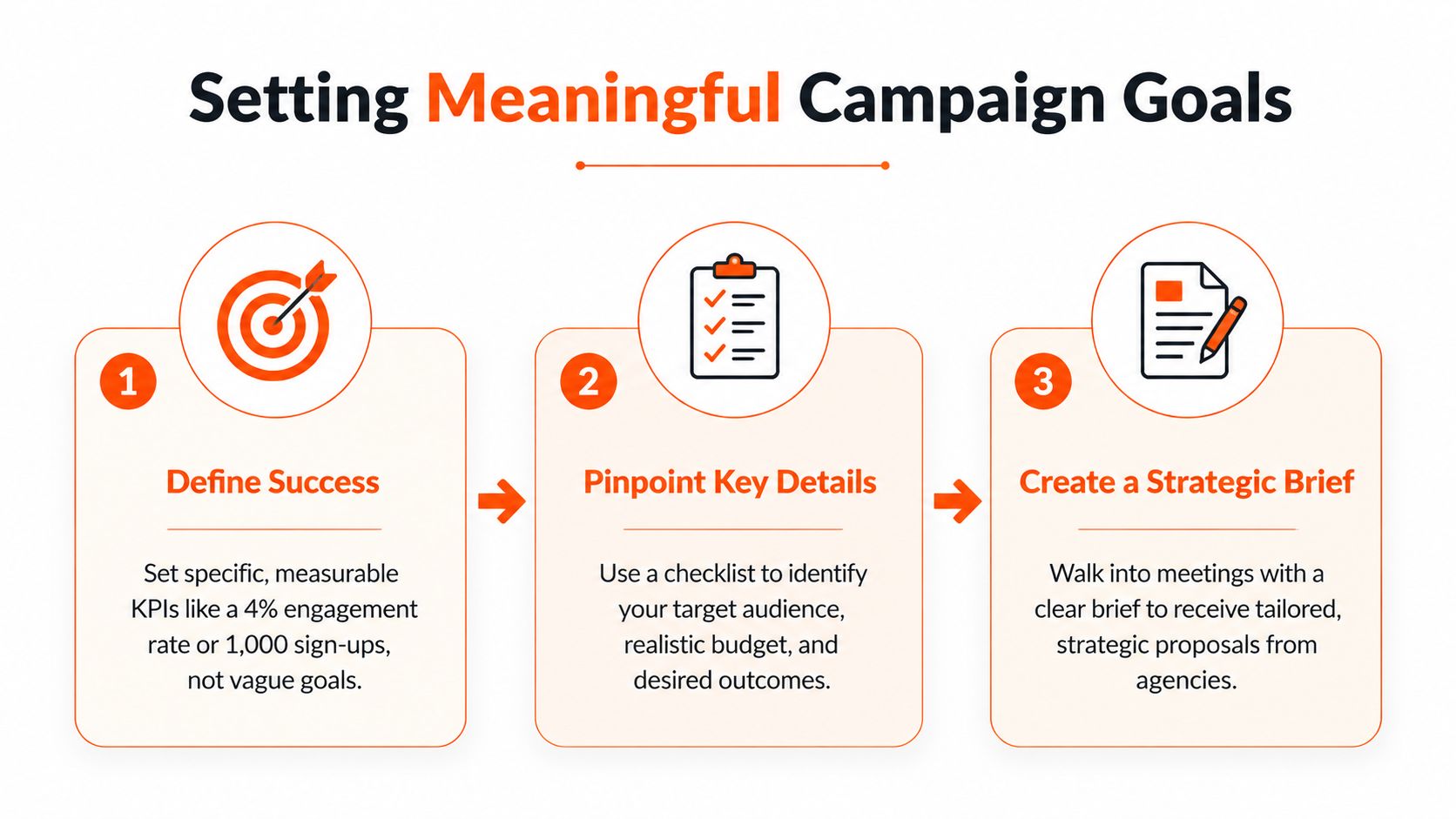
When you walk into those meetings with a clear brief, like the one in the infographic, you’re in a much stronger position. You can have more strategic discussions and get proposals that are actually suited to what you need. A bit of prep work like this makes it much easier to spot which influencer agencies are ready to become a proper extension of your team. Our own guide on our influencer marketing service explains in more detail how a dedicated partnership like this really works.
Decoding Agency Fees and Contract Structures
Let's talk money. Figuring out the financial side of working with an influencer agency can feel like you're trying to solve a puzzle in the dark. But once you understand the common models, it all becomes much clearer. Getting this right is about making sure your budget is working towards your goals, with no nasty surprises later on.
Most agencies you'll encounter will use one of three main pricing models. Each has its own place, and the best fit for your brand will really come down to your objectives and what you're trying to achieve with your campaign.
Common Agency Pricing Models
First up is the retainer model. This is a set monthly fee you pay the agency for their ongoing work. You can think of it as having an expert influencer marketing team on speed dial. This approach is brilliant for brands who are in it for the long haul, aiming for "always-on" influencer activity that builds the brand over time and allows for deeper strategic work.
Then you have commission-based pricing. With this one, the agency takes a percentage of the total campaign spend. For instance, if your budget for creator fees is £50,000, an agency might charge a 20% commission, meaning their fee is £10,000. It's a simple model that directly links their earnings to the size of your campaign.
Lastly, there's project-based pricing. Here, you agree on a single, flat fee for a specific campaign with a clear start and end date—like a new product launch or a big seasonal push. This is perfect for those one-off initiatives where the deliverables and timeline are locked in from the get-go.
Choosing the Right Structure for Your Goals
So, which one is for you? A monthly retainer helps build a proper partnership and gives you stability, which is exactly what you need if you're trying to develop brand ambassadors over the long term. On the other hand, a project fee gives you total cost certainty for a one-off campaign, making it great for dipping your toes in the water with a new agency.
Your choice of payment structure fundamentally shapes the agency relationship. A retainer builds a long-term strategic partnership, while a project fee is transactional. Align the model with your campaign's duration and complexity to ensure your investment drives the best possible return.
As you start getting proposals from different influencer agencies, don't just skip to the final number. You need to analyse how they’ve put their fees together. Does their proposal for a six-month brand-building campaign look like a retainer, as it probably should? Or is a quick two-week Christmas giveaway priced as a simple project fee?
For a deeper dive, our article explains how influencer agencies make money and what to look for in their financial setups. Understanding these details will put you in a much stronger position to negotiate better terms and find a partner whose success is tied to yours.
The Real Work Starts After the Contract Is Signed
You've picked your agency, signed on the dotted line, and you’re ready to go. A word of advice? Don’t just fire over a brief and wait for the magic to happen. A great influencer marketing campaign isn’t a simple transaction; it’s a partnership. And the first few weeks are where you lay the groundwork for success or failure.
Think of this initial phase as setting the rules of engagement. Get the boring but essential stuff sorted out first, and you’ll have a much smoother ride when the creative work kicks into high gear.
Who Talks to Whom, and When?
Miscommunication is the quickest way to kill a campaign's momentum. It’s also incredibly easy to avoid. The first thing you need to do is establish who your main point of contact is at the agency, and who theirs is on your team. This stops major decisions and feedback from getting lost in a sea of CC'd emails.
For the day-to-day chatter, a shared Slack or Microsoft Teams channel is perfect. But for the big picture stuff, you absolutely need a regular, scheduled call. This rhythm keeps everyone on the same page.
A solid communication plan might look something like this:
- Daily Chit-Chat: Use a shared channel for quick questions, file sharing, and informal updates.
- Weekly Huddle: A 30-minute video call to track progress, flag any issues, and look at the week ahead.
- Monthly Deep-Dive: A proper sit-down to go through the performance data against your KPIs and decide on any strategic pivots.
- Emergency Protocol: A clear process for who to call or email when something is on fire and needs immediate attention.
Get this agreed in your very first kickoff meeting. It prevents so much confusion down the line.

Don't Just Hand Over a Brief—Build It Together
Yes, you probably sent a brief over when you were vetting agencies. But your first job as official partners is to rip it apart and rebuild it together. The agency wasn't hired to just be a pair of hands; they were hired for their expertise.
This is where you see the real value. You might have your heart set on an Instagram Reels campaign to promote your new fitness app. But a good agency will bring their own data to the conversation. They might point out that for your specific goals, YouTube Shorts with a niche set of creators are currently delivering a 30% higher conversion rate for similar brands. That’s an insight you pay for.
A partnership thrives on shared ownership. Treat the agency as an extension of your own marketing team. Their success is your success, and fostering an environment of trust and mutual respect from day one will pay dividends throughout your campaigns.
When you co-create the strategy, it shifts the dynamic entirely. You’re no longer just a client, and they’re no longer just a vendor. You become a unified team working towards the same goal. When everyone is invested in the outcome, you’re far more likely to get the results you're after. Get this foundation right, and influencer agencies become a seriously powerful part of your growth machine.
Answering Your Top Questions About Influencer Agencies
As you get closer to teaming up with an agency, it’s only natural for a few questions to start bubbling up. You want to make a confident decision, and that means getting clear answers on the common "what ifs" that can feel a bit murky.
Let's break down some of the most frequent queries we hear from brands when they're on the brink of working with an influencer agency. Remember, this is all about finding a genuine partner, and any good one will be completely transparent. They should expect the tough questions and have solid answers ready to go.
How Long Are Agency Contracts?
One of the first things brands always wonder about is the commitment. Contracts with influencer agencies aren't a one-size-fits-all deal; they really depend on what you're trying to achieve.
- Project-Based: If you're planning a specific product launch or a seasonal push, you might sign a short-term contract for just 1-3 months. This is perfect for tactical, time-sensitive work.
- Retainer-Based: For those focused on long-term brand building, an ongoing retainer makes more sense. These contracts usually kick off with a minimum term, like 6 or 12 months, before shifting to a more flexible rolling agreement.
A longer-term partnership really lets an agency get under the skin of your brand. It allows them to build proper, lasting relationships with creators on your behalf and fine-tune performance over time. It’s less of a simple service and more of a true strategic alliance.
How Do Agencies Report on Performance?
You’ve set your KPIs, but how do you know if you're actually hitting them? Reporting is where the rubber meets the road, and you should expect a mix of real-time updates and deeper analysis. Most modern agencies now provide access to live dashboards where you can see campaign metrics as they roll in.
Beyond the live data, a typical reporting rhythm looks something like this:
- Weekly Updates: A quick summary of key activities and immediate performance stats.
- Monthly Performance Reviews: A detailed report digging into performance against your KPIs, highlighting what’s working and suggesting optimisations.
- Quarterly Business Reviews: A high-level strategy meeting to review the bigger picture, overall ROI, and plan for the next quarter.
This structure keeps you in the loop without drowning you in data.
What Happens if We Don’t Like the Chosen Influencers?
This is a totally fair question, but a professional agency has a process to make sure this is never really an issue. At the end of the day, you are always in the driver's seat. The agency's job is to put forward a shortlist of carefully vetted creators who nail your brief.
You will always have the final say. An agency’s role is to recommend and justify their creator selections based on data and expertise, but the approval to engage a creator ultimately rests with you, the brand.
You’ll get detailed profiles for each recommended influencer, covering their audience demographics, engagement stats, past work, and a clear reason why they’re a great fit. From there, you get to review, approve, or reject them before any outreach even starts. It’s a collaborative process that ensures the final lineup is one you’re genuinely excited about.
At Colossal Influence, we build partnerships on transparency and expertise. If you're ready to see how a leading UK influencer agency can deliver measurable results for your brand, explore our services at https://www.colossalinfluence.com.
Follow us on Social Media


